3 Succession Planning Steps You Can Start Today

Organizations can take three optimization steps to strengthen succession planning: identify key roles and successors, document essential knowledge, and develop future leaders. Acting now supports stability and prepares teams for leadership transitions. Many companies lack formal hiring systems for these processes, with only 35% having a succession plan. A structured approach reduces disruption for employees and customers, keeping operations steady.
Evidence Description | Impact on Organizational Stability |
|---|---|
A well-executed succession plan functions as a vital safeguard against the turbulence of unplanned leadership changes. | Reduces operational downtime and maintains productivity during leadership transitions. |
Key Takeaways
Start succession planning by identifying key roles that are crucial for your organization's success.
Document essential knowledge and skills for each key position to ensure smooth transitions.
Develop individual plans for potential leaders to help them grow and prepare for future roles.
Act early to avoid risks like low morale and talent gaps that can arise from delayed planning.
Engage employees in the process to boost their confidence and commitment to the organization.
Use structured templates and checklists to keep succession planning organized and effective.
Regularly review and update your succession plans to adapt to changes in the organization.
Celebrate successes in leadership transitions to motivate and encourage ongoing participation in succession planning.
Why Succession Planning Is Essential
Risks of Delaying
Organizations that postpone succession planning face several risks. Delays can threaten business legacy and reputation. Employees may feel uncertain about their future, which lowers morale and productivity. Companies without a clear plan often experience internal conflicts over leadership roles. Talent gaps emerge when potential leaders lack preparation. Stability declines, affecting daily operations and long-term growth.
Risk Type | Description |
|---|---|
Business Legacy | Delaying succession planning jeopardizes the business legacy, potentially harming its reputation. |
Employee Well-being | Employees may feel insecure about their future, leading to decreased morale and productivity. |
Company Value | The overall value of the company can decline due to lack of strategic planning for leadership. |
Internal Conflicts | Without a clear succession strategy, organizations may face internal disputes over leadership roles. |
Talent Gaps | Delays can create gaps in talent, as potential leaders may not be adequately prepared. |
Stability Decline | Overall stability of the organization may decrease, affecting operations and growth. |
Many business owners focus on daily operations instead of planning for the future. Some believe there is plenty of time to prepare, but effective transitions need careful preparation. Waiting until a leadership gap appears leaves organizations vulnerable. A structured plan includes contingency strategies that protect the company’s future.
Benefits of Early Action
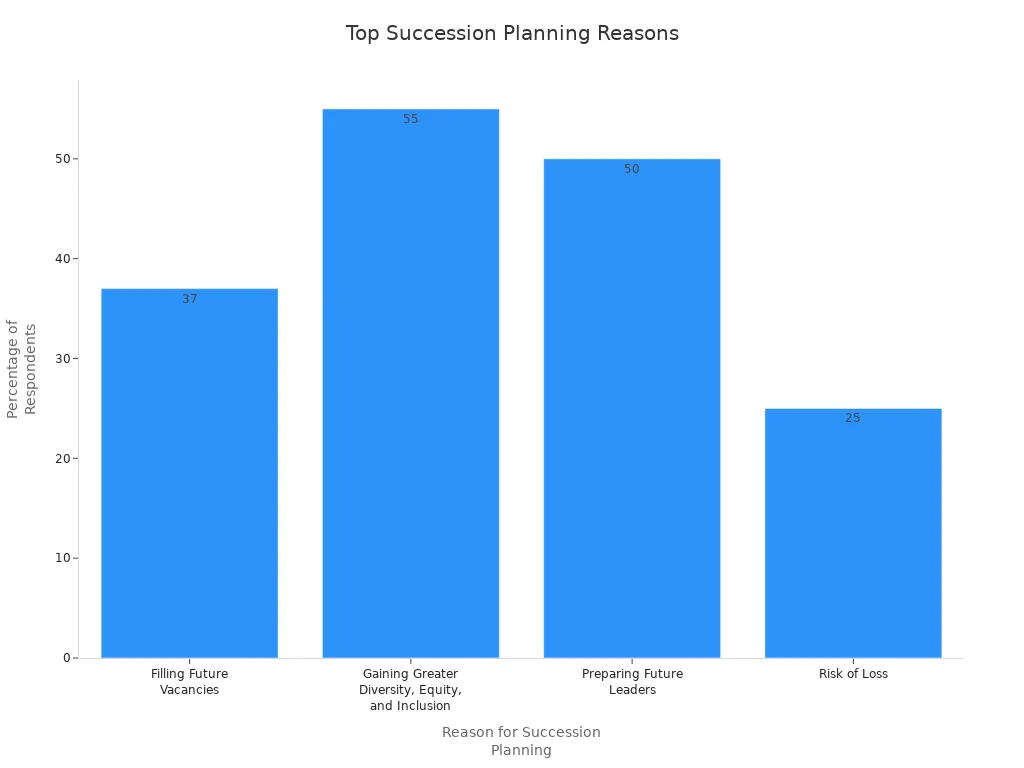
Early succession planning brings measurable advantages. Organizations report improved leadership continuity, which ensures smooth transitions in key roles. Employee engagement and morale rise when staff see clear paths for career growth. Developing internal talent reduces hiring and onboarding costs. A fair plan promotes leadership diversity and strengthens agility, allowing quick adaptation to market changes.
Benefit | Description |
|---|---|
Improved Leadership Continuity | Ensures smooth transitions in key roles, maintaining organizational goals. |
Increased Employee Engagement and Morale | Employees feel valued and see clear paths for career growth, leading to higher engagement. |
Reduced Hiring and Onboarding Costs | Developing internal talent cuts down on recruitment expenses significantly. |
Enhanced Leadership Diversity | A fair succession plan promotes equal access to growth opportunities, fostering diverse leadership. |
Strengthened Organizational Agility | A pipeline of talent allows for quick adaptation to market changes and new technologies. |
Improved Internal Mobility | Facilitates talent identification and development, creating a stronger pool of future leaders. |
Increased Investor and Stakeholder Confidence | A clear succession plan signals stability, enhancing trust and credibility with external parties. |
Early planning also boosts employee retention rates. Staff recognize that the organization values their growth and well-being. Focused programs deepen loyalty and provide clear career advancement paths. Companies retain crucial knowledge and skills, which supports long-term success.
Common Myths
Misconceptions about succession planning can hinder organizational readiness. Many believe that only large companies need a plan or that it is only necessary for C-level positions. Some think a ready-made replacement list is enough, but this leads to poor preparation. Others assume talent dashboards cover all needs, which overlooks critical readiness factors.
Succession planning is not just for imminent retirements or baby boomers. Every organization benefits from a proactive approach.
Untrue beliefs include the idea that succession plans are generic solutions or that future leaders should resemble current ones. Some think the board’s role ends after choosing a CEO, but ongoing involvement is vital. Annual reviews alone do not provide enough oversight in a changing business environment. Rushed transitions can destabilize the company and harm its value.
Succession planning requires strategic thinking and ongoing development.
It involves more than identifying replacements; it prepares leaders for future demands.
Organizations must align succession planning with leadership development and business strategy.
Step 1: Identify Key Roles & Successors

Critical Role Selection
Organizations begin succession planning by identifying which positions are most critical to their success. They look beyond job titles and consider the impact each role has on daily operations and long-term strategy. Some roles are difficult to fill from outside the company, and vacancies can disrupt business continuity. Leaders must evaluate which positions carry unique responsibilities or knowledge that would be hard to replace.
Criteria for Key Roles
A clear set of criteria helps organizations select key roles for succession planning. These criteria include the role’s influence on business outcomes, the skills required, and the need for a strong talent pool. The following table summarizes common criteria:
Criteria for Succession Planning | Description |
|---|---|
Role Impact | Identify roles that significantly affect organizational success. |
Skill Requirements | Determine necessary skills for key positions. |
Talent Pool Development | Create opportunities for skill-building among potential successors. |
Organizations also assess the urgency of succession, the effect on operations if the role becomes vacant, and the availability of internal or external candidates. They analyze the difficulty of replacing the role and consider its influence on organizational culture.
Tip: Leaders should avoid focusing only on obvious roles. Some positions with less visibility may have a major impact on business stability.
Tools for Identification
Several tools help organizations identify key roles. They use workforce segmentation models to analyze skills and value creation. Competency frameworks clarify the requirements for each position. HR data and performance metrics reveal which roles drive results and which may be vulnerable to turnover.
Analyze roles using skills-based segmentation.
Develop competency frameworks for each key position.
Use performance metrics to highlight high-impact roles.
Assessing Talent
After identifying critical roles, organizations assess internal talent to find potential successors. They review employee performance and aspirations, looking for those who show leadership qualities and motivation to grow.
Talent Assessment Methods
Effective talent assessment combines several methods. Leaders conduct regular performance evaluations and use tools like the 9-box grid to compare employee performance and growth potential. Competency-based assessments help pinpoint skills and readiness for future roles.
Conduct thorough assessments of current employees.
Use the 9-box grid to visualize performance and potential.
Implement regular talent reviews to keep assessments current.
Spotting High Potentials
Spotting high-potential employees requires careful observation. Leaders look for individuals who consistently exceed expectations and show interest in taking on new challenges. They invest in training and mentorship programs to nurture these employees, pairing them with experienced mentors for continuous learning.
Identify employees with strong leadership qualities.
Provide targeted training for required skills.
Pair high-potential staff with mentors to support development.
Prioritizing Roles
When resources are limited, organizations must prioritize which roles to address first in succession planning. They focus on positions that have the greatest impact on operations, are vulnerable to turnover, or require unique skill sets. The table below shows examples:
Example Roles | |
|---|---|
Impact on Operations | Operations Managers, Senior Technicians |
Vulnerability to Turnover | Maintenance Supervisors, Quality Control Inspectors |
Unique Skill Sets | Roles requiring proprietary technologies or specialized knowledge |
Senior leaders, department heads, and line supervisors often top the list. By analyzing HR data, organizations can identify additional high-impact roles that may not be immediately obvious. This approach ensures that succession planning strengthens business continuity and prepares the organization for future changes.
Step 2: Document Knowledge & Skills
What to Capture
Core Responsibilities
Organizations must capture the essential duties for each key role. These responsibilities guide successors and help maintain continuity. Leaders document daily tasks, decision-making authority, and project oversight. They also include refined processes, such as selecting materials for projects, which can determine success. Understanding the subtleties of client relationships ensures smooth transitions after leadership changes. Recording the history of successes and failures allows future leaders to replicate effective strategies and avoid past mistakes.
Daily operational duties
Decision-making authority
Project oversight steps
Refined processes for critical tasks
Client relationship nuances
History of successful and unsuccessful projects
Required Competencies
Documenting required competencies helps organizations prepare successors for future challenges. Leaders list technical skills, leadership abilities, and problem-solving techniques. They prioritize mission-critical, operational, and contextual knowledge. This approach ensures successors receive the information needed to perform effectively.
Technical expertise
Leadership skills
Problem-solving abilities
Mission-critical knowledge
Operational procedures
Contextual understanding
Organizing Information
Templates & Checklists
Structured templates and checklists help organize succession planning information. These tools standardize documentation and make it easier to update records. Organizations align their plans with long-term goals and industry challenges. The following table highlights best practices for organizing information:
Best Practice | Description |
|---|---|
Strategic Alignment | Align the succession plan with company goals to prepare leaders for challenges. |
Board Support | Encourage open dialogue and objective evaluation through board involvement. |
Early Planning | Identify successors early to prevent rushed decisions. |
Leadership Gap Assessment | Find capability gaps and tailor development programs. |
Adaptability | Keep plans flexible to respond to changing needs and events. |
Involving Role Holders
Role holders play a vital part in documenting knowledge and skills. They participate in knowledge transfer interviews and share insights with successors. Organizations embed knowledge capture into daily workflows, making it a routine part of work. Succession-focused knowledge sharing programs address cultural barriers and encourage collaboration. Leaders foster communities of practice and offer formal exchange programs, such as job shadowing and mentorship, to facilitate expertise sharing.
Tip: Pair experienced staff with successors to pass on critical institutional knowledge.
Keeping Records Current
Maintaining accurate records is essential for effective succession planning. Organizations evaluate succession plans at least annually. They conduct comprehensive reviews each year and assess critical positions quarterly. High-potential employee development receives monthly monitoring. Immediate reviews follow significant organizational changes or unexpected departures. Leaders update talent pipeline assessments, development progress, skills requirements, market conditions, and alignment with business strategy.
Annual comprehensive review
Quarterly assessment of critical positions
Monthly monitoring of high-potential employees
Immediate updates after major changes
Regular updates to skills and strategy alignment
Step 3: Develop Successors

Individual Development Plans
Individual development plans (IDPs) help future leaders grow in ways that match the needs of the organization. These plans focus on building strengths, addressing growth areas, and setting clear goals. Many organizations, including clients at systems and teams, use IDPs to create a strong leadership pipeline. They identify high-potential employees early and give them chances to lead projects or work in different departments.
Setting Goals
A good IDP includes several important parts:
Component | Description |
|---|---|
Strengths | Unique skills, knowledge, talents, and behaviors that help the team or company succeed. |
Development opportunities | Specific ways to grow, such as training courses or certifications. |
Long-term career vision | The big motivators and purpose that drive the employee, not just job titles. |
Short-term career plan | Steps to take in the next one to two years to reach the long-term vision. |
Growth areas | Career goals broken into smaller milestones, including training and development needs. |
Creating a leadership pipeline means finding high-potential employees early and giving them cross-functional opportunities, like project leadership or job rotations.
Aligning with Business Needs
IDPs should match the company’s strategy. They prepare top talent for future roles by focusing on the skills needed for leadership. This approach helps the organization meet its goals and ensures that leaders are ready for new challenges.
When succession plans align with the overall vision and objectives of the company, the development of future leaders supports long-term success and growth.
Training & Mentoring
Training and mentoring programs give successors the tools they need to lead. Clients at systems and teams have seen strong results by pairing experienced leaders with emerging talents and offering structured learning experiences.
On-the-Job Learning
On-the-job learning lets future leaders gain real experience. Rotational assignments and project leadership roles help them build new skills. This hands-on approach prepares them for bigger responsibilities.
Mentorship Programs
A formal mentorship program supports both mentors and mentees. The best programs include:
Key Element | Description |
|---|---|
Formal Mentorship Program | A structured program with clear goals for mentors and mentees. |
Resources for Mentors | Tools and information to help mentors guide their mentees. |
Regular Communication | Ongoing talks between mentors and mentees to solve problems and share advice. |
Continuous Evaluation | Regular checks to see if the program is working and to make changes if needed. |
A structured mentoring program gives direction and feedback. It helps future leaders learn from those with more experience.
Tracking Progress
Organizations measure the success of their development programs using clear metrics. They track how many key roles are filled by internal candidates, how long high-potential employees stay in their roles, and how many critical positions have several ready successors.
Metric | Description |
|---|---|
Critical Positions Filled Internally | Number of key roles filled by people already in the company. |
Average Time High-Potentials in Role | How long high-potential employees stay in the same role. |
Critical Positions with 3+ Successors | Number of key roles with at least three ready candidates. |
Average Years till Ready | Average time it takes for successors to be ready for their roles. |
Tip: Tracking promotion rates, retention, and team performance helps organizations see if their succession planning efforts are working.
Clients at systems and teams have used these steps to build strong leaders and keep their organizations stable during changes. By focusing on development, training, and progress tracking, they ensure a steady flow of talent for the future.
Overcoming Succession Planning Challenges
Succession planning often faces obstacles that can slow progress or reduce effectiveness. Organizations encounter resistance to change, confidentiality concerns, and fairness issues. Addressing these challenges helps build a stronger, more reliable succession process.
Handling Resistance
Resistance to succession planning can appear in many forms. Employees may worry about job security or feel uncertain about future changes. Leaders sometimes hesitate to discuss transitions, fearing disruption. Organizations can overcome resistance by using several proven strategies:
Initiate open dialogue to address concerns and foster understanding.
Highlight the risks of inaction to illustrate potential negative impacts.
Focus on shared goals and values to build consensus.
Start small to build momentum and demonstrate benefits gradually.
Create a sense of urgency to motivate action.
Lead by example to inspire confidence in the process.
Seek compromise and collaboration to involve all stakeholders.
Open communication and visible leadership support encourage employees to participate in succession planning. When organizations show the benefits and create a sense of urgency, teams become more willing to engage.
Managing Confidentiality
Confidentiality remains a key concern in succession planning. Organizations must protect sensitive information about candidates and future plans. At the same time, secrecy can prevent potential successors from preparing for advancement. Balancing transparency and privacy requires careful planning.
Common challenges include:
Narrow focus on executive roles, which can leave other positions unaddressed.
One-size-fits-all approaches that ignore unique role requirements.
Reliance on a single successor, creating risk if that person is unavailable.
Secrecy that limits preparation and engagement.
Organizations should share enough information to help employees understand the process, while keeping personal details private. Regular updates and clear guidelines help maintain trust without exposing confidential data.
Ensuring Fairness
Fairness in succession planning builds trust and supports a positive workplace culture. Organizations must treat all candidates equally and use a standardized selection process. This approach reduces both intentional and unintentional bias.
Fairness Practice | Description |
|---|---|
Standard Criteria | Use clear, consistent criteria for candidate selection. |
Role Definition | Define roles to remove bias and promote equity. |
Systematic Checks | Implement measures to reduce bias throughout the process. |
Effective Communication | Keep stakeholders informed to manage expectations. |
Leadership Involvement | Engage current leaders to foster ownership and alignment. |
Keeping key employees informed and involving leaders in the process reduces uncertainty. When organizations communicate openly and follow fair procedures, employees feel valued and motivated to grow.
Succession planning works best when organizations address resistance, protect confidentiality, and ensure fairness. These steps help create a stable environment where future leaders can thrive.
Embedding Succession Planning in Culture
Building a Talent Pipeline
Organizations build strong talent pipelines by investing in employee development and identifying high-potential individuals. They use assessments and performance reviews to spot future leaders. Senior leaders play a key role by engaging in succession discussions and granting authority for succession plans. Companies connect promising employees with experienced mentors and coaches. Leadership development programs help employees learn strategic thinking and communication skills.
Embrace talent pools for leadership roles
Implement formal training and coaching programs
Assess internal talent for potential successors
Invest in employee development programs
Utilize mentorship programs to guide future leaders
A robust talent pipeline ensures leadership continuity and reduces costs linked to external hiring. Employees see clear paths for growth, which boosts engagement. This approach also helps transfer institutional knowledge, keeping operations stable during transitions.
Ongoing Development
Continuous development supports succession planning and prepares employees for future roles. Organizations create development plans for potential successors and encourage career path discussions. Job shadowing and mentorship programs enhance skills and confidence. Regular reviews and HR analytics help align succession plans with company goals.
Ongoing development keeps employees ready for new challenges and supports business growth.
Companies use DEI dashboards to measure employee sentiment and conduct audits to identify biases in promotions. They leverage HR analytics for turnover insights. These practices help organizations maintain fairness and transparency in succession planning.
Practice | Benefit |
|---|---|
Regular reviews | Keeps plans up to date |
Designated plan owner | Ensures accountability |
Leadership engagement | Strengthens commitment |
Mentorship and coaching | Builds essential skills |
Career path discussions | Clarifies growth opportunities |
Celebrating Success
Recognizing achievements motivates employees and reinforces the value of succession planning. Organizations celebrate when employees reach milestones or move into new leadership roles. They share success stories to inspire others and highlight the impact of development programs.
Share stories of successful transitions
Recognize employees who complete development plans
Celebrate promotions and new appointments
Encourage peer recognition for leadership growth
🎉 Celebrating success creates a positive culture and encourages ongoing participation in succession planning. Employees feel valued and motivated to pursue leadership opportunities. This approach helps embed succession planning into the company’s everyday practices.
Succession Planning Action Checklist
A clear checklist helps organizations start succession planning and maintain progress. This section provides practical steps, review methods, and resources that support leadership continuity.
Quick-Start Steps
Organizations can begin succession planning by following these simple actions:
List Critical Roles
Identify positions that impact business stability and growth.Assess Internal Talent
Review employee performance and potential for leadership.Document Key Knowledge
Record essential responsibilities and skills for each role.Create Development Plans
Set goals for high-potential employees and outline training needs.Assign Mentors
Pair future leaders with experienced staff for guidance.
Tip: Start with one department or team to build momentum. Small wins encourage wider adoption.
Regular Review Process
Regular reviews keep succession plans current and effective. Organizations should schedule evaluations and update records as needed.
Review Frequency | Activity | Responsible Party |
|---|---|---|
Annual | Full succession plan review | HR and Leadership |
Quarterly | Critical role and talent assessment | Department Heads |
Monthly | High-potential employee progress check | Managers |
After Major Changes | Immediate plan update | HR and Leadership |
Leaders should track progress using clear metrics. They monitor promotions, retention rates, and readiness of successors. Regular feedback sessions help identify gaps and adjust development plans.
Note: Consistent reviews prevent outdated information and support quick responses to unexpected changes.
Resources for Support
Organizations can access many resources to strengthen succession planning. These tools and services provide guidance and structure.
Templates and Checklists
Downloadable forms help standardize documentation and planning.HR Software
Digital platforms track talent, progress, and development needs.Mentorship Program Guides
Step-by-step instructions support mentor-mentee relationships.Training Providers
External courses and workshops build leadership skills.Professional Associations
Groups offer best practices, networking, and expert advice.
Resource Type | Example Use Case |
|---|---|
Templates | Document role responsibilities |
HR Software | Monitor talent pipeline |
Mentorship Guides | Structure mentoring programs |
Training Providers | Develop leadership competencies |
Associations | Access industry insights |
📝 Organizations that use available resources build stronger succession plans and prepare leaders for future challenges.
Succession planning starts with three clear steps: identifying key roles and successors, documenting essential knowledge, and developing future leaders. Each step builds stability and prepares organizations for change. Taking action today, even with a small step, strengthens leadership continuity. Succession planning works best as an ongoing process. For guidance or support, readers can contact systems and teams to learn more about effective succession planning. 🚀
FAQ
What is succession planning?
Succession planning prepares organizations for future leadership changes. It identifies key roles, documents essential knowledge, and develops potential leaders. This process helps maintain stability and supports long-term growth.
Who should participate in succession planning?
Senior leaders, HR professionals, and department managers play important roles. Employees with high potential also contribute by sharing knowledge and engaging in development programs.
How often should organizations review succession plans?
Organizations should review succession plans at least once a year. Quarterly assessments for critical roles and monthly checks for high-potential employees help keep plans current.
What tools help with succession planning?
HR software, templates, and checklists organize information. Mentorship guides and training resources support development. These tools make the process easier and more effective.
How can organizations ensure fairness in succession planning?
Standard criteria, clear role definitions, and systematic checks reduce bias. Effective communication and leadership involvement build trust and promote equity.
Why is documenting knowledge important?
Documenting knowledge preserves essential skills and responsibilities. It helps successors learn quickly and reduces disruption during transitions.
What are common challenges in succession planning?
Resistance to change, confidentiality concerns, and fairness issues often arise. Open communication, clear guidelines, and regular reviews help address these challenges.
Can small organizations benefit from succession planning?
Small organizations gain stability and continuity by planning for leadership changes. Succession planning helps retain talent and prepares teams for future growth.


