Six Sigma Methodology helps fix common mistakes fast

Six Sigma Methodology offers organizations a rigorous, data-driven way to fix business process mistakes. Teams use statistical tools such as control charts and hypothesis testing to spot defects and measure improvements. Experts note that a Six Sigma process means only 3.4 defects per million, showing near-perfect consistency.
Ford Motor Company adopted Six Sigma to reduce production defects, achieving a defect rate of only 7 per million. This led to noticeable quality improvements and increased customer satisfaction.
Systems that follow this methodology help organizations deliver reliable products and services. Many companies report significant cost savings and better use of resources after adopting Six Sigma.
Key Takeaways
Six Sigma Methodology uses data-driven tools to identify and fix business process mistakes quickly.
Organizations can achieve near-perfect consistency with only 3.4 defects per million opportunities by applying Six Sigma.
Common business mistakes include human errors, process inefficiencies, and communication gaps that slow growth.
The DMAIC framework (Define, Measure, Analyze, Improve, Control) guides teams through structured problem-solving.
Using tools like Fishbone diagrams and the 5 Whys helps teams uncover root causes of issues effectively.
Regular monitoring and training are essential to sustain improvements and prevent old mistakes from returning.
Implementing Six Sigma can lead to significant cost savings, improved quality, and higher customer satisfaction.
Building a culture of continuous improvement empowers all employees to contribute to quality enhancements.
Common Process Mistakes

Frequent Errors in Business
Businesses face many common mistakes that slow growth and reduce quality. These errors often arise from human mistakes, process inefficiencies, and communication gaps.
Human Mistakes
Human errors occur when employees make wrong decisions or overlook details. These mistakes include failing to learn from past reports and overestimating financial projections. For example, teams sometimes underestimate costs or ignore external factors that affect outcomes. Such errors can cause delays and increase defects in products or services.
Process Inefficiencies
Many organizations struggle with inefficient processes. These include time-consuming steps, processes prone to errors, and poor use of resources. When workflows lack standardization, teams waste time and effort. Using the wrong metrics or not standardizing data processes also leads to confusion and mistakes. These inefficiencies reduce productivity and increase operational costs.
Communication Gaps
Communication gaps happen when teams do not share information clearly or timely. Misunderstandings between departments cause delays and errors. Poor communication can also lead to inconsistent data reporting and unclear instructions. These gaps often result in repeated mistakes and frustration among employees.
Impact on Performance
Mistakes in business processes affect overall performance in many ways. The table below shows common impacts of reporting and process errors:
Impact of Reporting Mistakes | Description |
|---|---|
Unclear Insights | Leads to misinformed decisions and delays in action. |
Ignoring External Factors | Results in misleading reports that do not reflect true performance. |
Inaccurate Data Interpretation | Causes misattribution of successes or failures, hindering strategy. |
Poor Visual Presentation | Confusing visuals can lead to misreading trends and insights. |
One-Size-Fits-All Reports | Fails to meet needs of different stakeholders, causing disengagement. |
Recurring Errors | Undetected mistakes lead to repeated issues, reducing confidence. |
These impacts show how mistakes can slow decision-making and reduce trust in data. They also increase costs and lower customer satisfaction.
Why Mistakes Persist
Mistakes continue because many organizations do not use structured methods to identify and fix root causes. Teams often rely on guesswork or incomplete data. They may also resist change or lack training in quality management. Without clear processes, errors repeat and grow worse.
The Six Sigma Methodology helps solve this problem by using data-driven tools to find and fix mistakes quickly. It encourages continuous improvement and standardizes processes to reduce variation. Organizations that apply Six Sigma see fewer defects and better performance over time.
Understanding common mistakes and their effects helps businesses focus on areas needing improvement. Using proven methods like Six Sigma Methodology speeds up problem-solving and drives lasting success.
Six Sigma Methodology for Fast Identification

Six Sigma Methodology stands out for its ability to quickly pinpoint the root causes of business process mistakes. Teams use structured, data-driven tools to collect information, analyze trends, and identify where problems begin. This approach helps organizations move beyond guesswork and address issues with precision.
Data-Driven Analysis
Measuring and Collecting Data
Teams start by gathering both qualitative and quantitative data. They focus on collecting information that reveals how processes perform and where errors occur. Common data types include defect counts, process times, and customer feedback. Statistical Process Control (SPC), control charts, and Failure Mode and Effects Analysis (FMEA) help teams monitor performance and spot irregularities.
For example, a business aiming to reduce defects in its manufacturing line might collect data on defect counts at each production stage. By analyzing this data with regression analysis or hypothesis testing, teams can uncover the main sources of defects and target improvements.
The table below shows how data-driven analysis can lead to measurable improvements:
Metric | Before Six Sigma | After Six Sigma | Improvement |
|---|---|---|---|
Defects per Million Opportunities (DPMO) | 4,500 DPMO (3.2σ) | 500 DPMO (4.8σ) | Significant reduction in defects |
Cost per Unit | High | Reduced | Cost savings achieved |
Customer Satisfaction | Low | High | Enhanced customer satisfaction |
Finding Patterns
After collecting data, teams look for patterns that reveal the underlying causes of mistakes. They use statistical tools such as hypothesis testing, ANOVA, regression, and correlation to analyze relationships between variables. These tools help teams distinguish between random variation and real problems that need attention.
Qualitative and quantitative data
Statistical analysis
Root cause analysis tools like Fishbone diagrams and 5 Whys
Statistical tools such as hypothesis testing, ANOVA, regression, and correlation
Root Cause Tools
DMAIC Overview
DMAIC stands for Define, Measure, Analyze, Improve, and Control. This cycle guides teams through a structured problem-solving process. Teams define the problem, measure current performance, analyze data to find root causes, implement improvements, and control the process to sustain gains. The DMAIC cycle ensures that decisions rely on data, not assumptions, which speeds up the identification of process mistakes.
Fishbone Diagram, 5 Whys
Teams often use the Fishbone Diagram, also called the Ishikawa diagram, to organize potential causes of a problem into categories such as People, Process, Machine, Materials, Measurement, and Environment. The 5 Whys technique encourages teams to ask "why" multiple times until they reach the root cause of an issue. These tools help teams break down complex problems and focus on the most important factors.
Fishbone Diagram: Organizes possible causes by category.
5 Whys: Uses repeated questioning to uncover the root cause.
Pareto Analysis: Highlights the most common sources of defects.
Speed vs. Traditional Methods
Six Sigma Methodology accelerates problem identification compared to traditional approaches. Traditional methods often rely on intuition or incomplete data, which can delay solutions. Six Sigma uses real-time monitoring, predictive analytics, and advanced statistical tools to spot issues early and intervene before defects escalate.
Tracks process performance over time
Distinguishes between common cause and special cause variations
Allows timely intervention before defects escalate
A case study shows that process mining can enhance Lean Six Sigma by providing detailed, real-time data. This data reveals not only the existence of a problem but also the exact factors causing it. Teams can monitor processes continuously and act immediately when performance drops.
Six Sigma Methodology combines structured analysis, powerful tools, and real-time data to help organizations identify and fix mistakes faster than ever before.
Fixing Mistakes with Six Sigma
Six Sigma teams use a structured approach to fix business process mistakes quickly and effectively. The DMAIC framework guides teams through each step, ensuring that solutions address the real causes of problems and deliver lasting improvements.
DMAIC Steps
DMAIC stands for Define, Measure, Analyze, Improve, and Control. Each phase plays a unique role in solving process issues and driving rapid results.
Phase | Purpose | Contribution to Problem Resolution |
|---|---|---|
Define | Identify the problem and set project goals based on customer needs. | Establishes the problem and project goals, ensuring focus and engagement. |
Measure | Collect data to establish current process performance baselines. | Quantifies current performance to establish a reliable baseline for improvements. |
Analyze | Identify root causes of inefficiencies or defects through data analysis. | Identifies root causes of inefficiencies using data analysis. |
Improve | Implement targeted solutions to address verified root causes. | Develops and implements solutions to eliminate identified issues. |
Control | Monitor the improved process and sustain gains over time. | Ensures that improvements are sustained over time through monitoring and standardization. |
Define
Teams begin by clearly stating the problem and setting goals that match customer needs. They gather input from stakeholders and outline the project scope. This step ensures everyone understands the issue and works toward the same objective.
Measure
In this phase, teams collect data to understand how the current process performs. They use tools like process maps and control charts to track key metrics. Accurate measurement helps teams set a baseline and identify where mistakes occur.
Analyze
Teams examine the data to find the root causes of defects or inefficiencies. They use statistical analysis, Fishbone diagrams, and the 5 Whys technique to dig deeper into the problem. This step prevents teams from treating only the symptoms.
Improve
After identifying the root causes, teams develop and test solutions. They may redesign workflows, automate steps, or provide targeted training. The goal is to fix the problem at its source and verify that the changes lead to measurable improvements.
Control
Teams monitor the improved process to make sure gains last. They create control plans, update documentation, and train staff on new procedures. Regular checks help prevent old mistakes from returning.
Tip: Teams that follow the DMAIC steps can reduce defects, improve quality, and increase efficiency. This approach also helps lower costs and boost customer satisfaction.
Rapid Problem Solving Examples
Many organizations have used Six Sigma to solve problems quickly and achieve impressive results. The following table shows real-world examples:
Company | Application of Six Sigma | Result |
|---|---|---|
Amazon | Used DMAIC to reduce errors | Improved customer satisfaction scores by 5% from 2021 to 2024 |
Motorola | Reported savings of $17 billion | Reduced process variation and defects, leading to better products and services |
Amazon applied the DMAIC process to reduce errors in its operations. The company tracked performance, found the main sources of mistakes, and implemented targeted solutions. As a result, customer satisfaction scores improved by 5% over three years.
Motorola used Six Sigma to cut process variation and defects. The company saved $17 billion by standardizing processes and focusing on quality. These examples show how teams can achieve rapid and lasting improvements by following a structured approach.
Team Roles
Successful Six Sigma projects depend on clear roles and responsibilities. Each team member brings unique skills to the process:
Green Belts lead project teams, analyze data, and train Yellow Belts. They report progress to management and help drive improvements.
Black Belts manage large-scale projects and use advanced statistical tools. They mentor other belts and align projects with company strategy.
Master Black Belts guide teams across the organization. They shape quality improvement strategy, train Black Belts and Green Belts, and solve complex problems.
These roles ensure that teams have the expertise needed to identify mistakes, implement solutions, and sustain improvements. When organizations use Six Sigma Methodology, they build strong teams that can respond quickly to challenges and deliver better results.
Why Six Sigma Methodology Is Effective
Comparison with Traditional Methods
Traditional problem-solving methods often rely on intuition, experience, or trial and error. These approaches can take longer to identify issues and may not address root causes effectively. Teams might fix symptoms instead of problems, leading to recurring mistakes and wasted resources.
In contrast, Six Sigma Methodology uses a structured, data-driven process. It relies on statistical tools and clear steps to find and solve problems quickly. This approach reduces guesswork and speeds up decision-making. Teams can detect defects early and prevent them from affecting customers.
Six Sigma also focuses on customer needs and process variation. It aims to deliver consistent quality and faster results. This focus helps organizations improve customer satisfaction more reliably than traditional methods.
Benefits of Structure and Tools
Using structured tools in Six Sigma Methodology brings many advantages:
Reduces defects and variation by identifying root causes and eliminating factors that cause errors.
Improves customer satisfaction by addressing quality and service issues for faster, reliable outcomes.
Cuts costs and waste through better resource use and streamlined workflows.
Reveals bottlenecks and unnecessary steps to make processes more efficient.
Increases efficiency and speed by reducing rework and standardizing procedures.
Provides a repeatable, data-driven problem-solving approach that supports evidence-based decisions.
Enhances employee engagement by involving staff at all levels in improvement efforts.
Maintains a strong customer focus to create greater value and loyalty.
These benefits help teams deliver better products and services while saving time and money.
Case Studies on Speed and Results
Many organizations have seen fast, measurable improvements using Six Sigma Methodology. The table below highlights some examples:
Case Study | Focus | Baseline | Results | Impact |
|---|---|---|---|---|
Streamlining guest check-in and checkout | Average check-in time 8.5 minutes | Reduced to 3.2 minutes | Increased guest satisfaction by 28% | |
General Electric - Welding Process | Defect rate 12% | Reduced to 2.1% | 82% improvement | Annual savings of $1.98 million |
Mayo Clinic - Emergency Department Wait | Average wait time 4.2 hours | Reduced to 1.8 hours | 57% improvement | Satisfaction scores rose to 85th percentile |
Bank of America - Loan Processing | Processing time 45 days | Reduced to 18 days | 60% improvement | $4.2 million annual operational cost reduction |
Dell Technologies - Supply Chain | Order-to-delivery time 21 days | Reduced to 7 days | Significant reduction | Decreased inventory holding costs by $47 million annually |
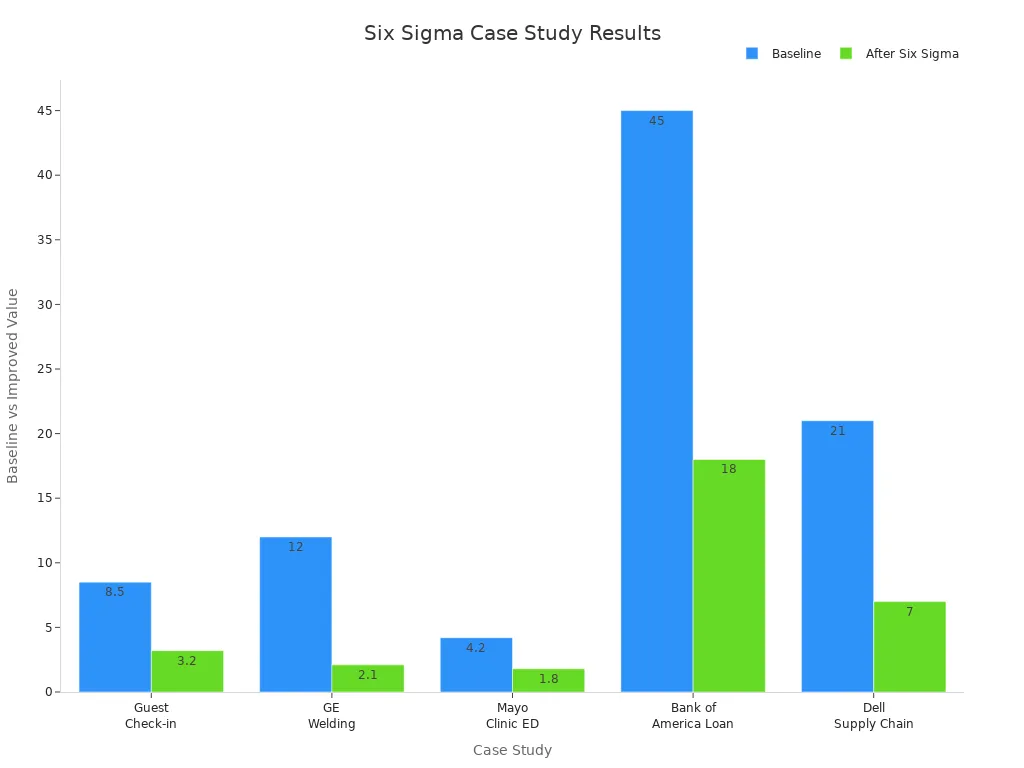
These examples show how Six Sigma Methodology helps organizations reduce time, defects, and costs while improving customer satisfaction. The structured approach delivers fast, reliable results that traditional methods often cannot match.
Practical Tips for Six Sigma Success
Getting Started
Organizations that want to succeed with Six Sigma should begin by identifying processes that need improvement. These often include workflows that take too much time, have frequent errors, or waste resources. Focusing on these areas helps teams target efforts where they matter most.
Next, teams should redesign processes to remove waste, reduce variation, and boost efficiency. This step often involves simplifying steps, standardizing procedures, and eliminating unnecessary tasks. Clear goals and measurable targets help guide these changes.
Sustaining improvements requires ongoing effort. Teams must monitor performance regularly to catch any decline early. Training employees on new processes ensures everyone understands their roles and follows best practices. Making adjustments based on feedback keeps improvements effective over time.
Tip: Starting with small, manageable projects builds confidence and shows quick results. This approach encourages wider adoption of Six Sigma across the organization.
Key Tools for Quick Wins
Several Six Sigma tools help teams achieve fast, visible improvements:
Predictive Analytics uses past data to forecast outcomes and spot risks. This tool helps teams act before problems grow.
Robotic Process Automation (RPA) automates repetitive tasks, reducing errors and speeding up workflows.
Dashboards display real-time key performance indicators. They allow managers to make quick, informed decisions.
Control Plans define how to monitor critical process parameters. These plans keep improvements stable and consistent.
Using these tools early in projects can deliver quick wins. They provide clear insights and reduce manual work, helping teams focus on solving root causes rather than symptoms.
Avoiding Pitfalls
Many organizations face common challenges when applying Six Sigma. Recognizing these pitfalls helps teams avoid costly mistakes:
Lack of Leadership Commitment: Without strong support from leaders, projects may lose momentum. Building a coalition of middle managers who champion Six Sigma can help. Framing projects around business value also gains leadership buy-in.
Employee Resistance and Poor Change Management: Change often meets resistance. Communicating openly and involving employees in decisions fosters ownership. Using data to understand resistance sources guides better strategies.
Inadequate Training and Resources: Teams need proper training tailored to their roles. Allocating time and resources for project work ensures progress.
Flawed Project Selection and Scope Creep: Choosing the right projects matters. Using a project selection matrix and clearly defining scope prevents wasted effort and confusion.
Difficulty with Data Collection and Analysis: Defining metrics before collecting data improves accuracy. Encouraging a culture of data honesty supports reliable analysis.
Losing Momentum and Failing to Sustain Gains: Standardizing new processes and linking them to performance metrics helps maintain improvements. Regular reviews prevent backsliding.
Note: Addressing these challenges early increases the chances of Six Sigma success and long-term benefits.
By following these practical tips, organizations can apply Six Sigma effectively, avoid common traps, and build a culture of continuous improvement.
Building Improvement Culture
A strong improvement culture forms the backbone of successful Six Sigma organizations. Companies that excel in quality do not treat process improvement as a one-time project. They make it a daily habit. This mindset encourages everyone to look for ways to make small, positive changes.
Leaders play a key role in shaping this culture. They set high standards and hold teams accountable for results. When leaders support Six Sigma, employees feel empowered to suggest ideas and take ownership of improvements. Leadership support also ensures that resources and training reach every level of the organization.
Training stands as another pillar of improvement culture. Companies like Motorola and General Electric have invested in Six Sigma certification programs for their employees. These programs build skills in data analysis, problem-solving, and teamwork. Well-trained employees can spot issues early and use proven tools to fix them. Over time, this investment leads to optimized processes and better performance.
A culture of continuous improvement grows stronger when every employee feels responsible for quality. Teams that share knowledge and celebrate small wins build momentum. Employees who see their ideas put into action become more engaged and motivated.
Tip: Encourage open communication and recognize contributions from all team members. This approach helps sustain enthusiasm for improvement.
Organizations can use several strategies to build and maintain this culture:
Cultivate a philosophy of continuous improvement and quality excellence.
Foster a mindset where every employee commits to making small changes.
Emphasize the importance of training for all employees.
Ensure leadership support to establish accountability and high standards.
Key roles also support the improvement culture:
Project leader: Guides the DMAIC project and promotes data-driven decisions.
Project team: Brings together cross-functional members trained in Six Sigma tools to identify root causes.
Champion (Executive sponsor): Aligns projects with company strategy and provides necessary resources.
By focusing on these elements, organizations create an environment where improvement becomes part of everyday work. This culture not only reduces mistakes but also drives long-term success and operational excellence.
Measuring and Sustaining Improvement
Tracking Progress
Teams use clear metrics to track progress in Six Sigma projects. These metrics help leaders see if improvements work and where more effort is needed. The table below shows common metrics used in Six Sigma:
Metric Type | Description |
|---|---|
Measures costs from defects, rework, and failures. Highlights areas for improvement. | |
Labor Cost per Unit | Assesses how efficiently teams use labor. Shows potential cost savings. |
Scrap Rate/Waste Reduction | Quantifies waste produced compared to total output. Essential for tracking efficiency. |
Defect Rate | Counts defective units produced. Critical for quality control. |
Customer Complaints/Returns | Reflects external quality issues and customer satisfaction. |
Rework Percentage | Shows how many products need extra work. Highlights inefficiencies. |
Measures how much process time decreases. Indicates efficiency gains. | |
Productivity Improvements | Tracks output per unit of input. Reflects operational effectiveness. |
Project Completion Rates | Shows percentage of projects finished on time and within scope. |
Financial Benefits Realized | Assesses monetary gains from process improvements. |
Project Duration | Tracks total time to complete a project. Helps spot delays. |
Implementation Speed | Measures how quickly teams put improvements into practice. |
Teams review these metrics regularly. They use dashboards and reports to share results with everyone involved. This approach keeps projects on track and supports data-driven decisions.
Ensuring Stability
Organizations must make sure improvements last over time. They can follow these steps:
Build a culture that values continuous improvement. Leaders reward teams for finding and fixing problems.
Standardize processes to keep results consistent and reduce variation.
Identify key performance indicators (KPIs) to monitor process health.
Conduct regular audits and reviews to check compliance with Six Sigma principles.
Provide ongoing training so employees keep their Lean Six Sigma skills sharp.
Teams also use change management principles. They help employees understand and accept new ways of working. This support ensures that improvements become part of daily routines. When organizations combine change management with Six Sigma, they achieve higher-quality outcomes and create a culture that values progress.
Tip: Regular feedback and open communication help teams spot issues early and keep improvements stable.
Scaling Success
Organizations can expand Six Sigma success across many business units by using a systematic approach. They focus on data analysis to guide decisions and improve scalability. Teams use the DMAIC framework as the backbone of their strategy. This method connects process excellence with overall business performance.
Leverage Six Sigma’s structured approach to boost efficiency.
Encourage Black Belts to think in systems, not just in silos. This mindset helps solve challenges across the whole organization.
Share best practices and lessons learned between teams.
Use data to measure results and guide future projects.
By following these strategies, organizations can spread the benefits of Six Sigma. They achieve better results in more areas and build a strong foundation for continuous improvement.
Six Sigma Methodology empowers teams to quickly spot and fix common business mistakes. Teams use data-driven decisions, focus on process improvement, and encourage collaboration for lasting results. Reducing defects and minimizing variation leads to better product quality, cost savings, and higher customer satisfaction. To get started, organizations should identify key areas for improvement, implement changes, and train employees. For more guidance or resources on applying Six Sigma, readers can reach out to learn how to build a culture of continuous improvement.
FAQ
What is Six Sigma?
Six Sigma is a quality management methodology. It uses data and statistical tools to reduce defects and improve processes. Teams follow structured steps to find and fix mistakes.
How does Six Sigma differ from other quality methods?
Six Sigma relies on data-driven analysis and structured frameworks like DMAIC. Other methods may use intuition or less rigorous tools. Six Sigma aims for measurable results and continuous improvement.
Who can use Six Sigma in an organization?
Any employee can participate in Six Sigma projects. Green Belts, Black Belts, and Master Black Belts lead teams. Leaders support projects and provide resources.
What are the main tools used in Six Sigma?
Teams use tools like Fishbone diagrams, 5 Whys, control charts, and process maps. These tools help identify root causes and track improvements.
How long does it take to see results with Six Sigma?
Many organizations see improvements within a few months. Small projects often deliver quick wins. Larger projects may take longer but provide lasting benefits.
Can Six Sigma work in non-manufacturing industries?
Six Sigma applies to many fields, including healthcare, finance, and service industries. Teams use the same principles to improve processes and reduce errors.
What are common challenges when implementing Six Sigma?
Teams may face resistance to change, lack of leadership support, or difficulty collecting data. Training and clear communication help overcome these challenges.
How does Six Sigma improve customer satisfaction?
Six Sigma reduces defects and variation. Teams focus on meeting customer needs and delivering consistent quality. Improved processes lead to happier customers.


