Lean Thinking can solve common business problems fast
Lean Thinking presents a practical approach for rapid business management improvements. Many industries, such as manufacturing, banking, airlines, and startups, use Lean Thinking to address process challenges and deliver value quickly. Companies like Amazon and Delta Airlines optimize hiring systems and reduce lead times with proven optimization steps. Research highlights the need for empirical evidence and quantitative analysis in evaluating Lean practices. The methodology’s widespread adoption shows its accessibility and effectiveness in eliminating waste and enhancing business outcomes.
Lean Thinking has been widely adopted in sectors including manufacturing, healthcare, services, and government.
Evidence Type | Description |
|---|---|
Empirical Basis | Practitioners rely on empirical evidence rather than subjective opinions. |
Need for Quantitative Analyses | Statistical methods verify lean practices and focus on major factors. |
Key Takeaways
Lean Thinking helps organizations improve processes quickly by focusing on customer value and eliminating waste.
Core principles include value creation, waste reduction, continuous improvement, and respect for people, which drive better performance.
Identifying and removing inefficiencies, such as unnecessary steps and delays, leads to faster workflows and lower costs.
Engaging employees in improvement initiatives fosters a culture of accountability and innovation, enhancing overall productivity.
Using tools like Value Stream Mapping and 5S helps teams visualize workflows and streamline operations effectively.
Starting with small changes allows teams to build confidence and momentum, leading to larger improvements over time.
Regularly tracking progress and celebrating small wins keeps teams motivated and focused on continuous improvement.
Lean Thinking is applicable to any organization, from large corporations to small businesses, making it a versatile approach for operational success.
Lean Thinking Overview

Lean Thinking Defined
Lean Thinking serves as a philosophy, framework, and practical method for improving business operations. This approach helps organizations optimize resource planning and deliver maximum value to clients while minimizing waste. Companies use Lean Thinking to analyze processes, identify inefficiencies, and make changes that enhance productivity. The methodology encourages teams to focus on what customers truly value and to streamline activities that contribute to that value.
Core Principles
Lean Thinking relies on several core principles that guide organizations toward better performance and customer satisfaction.
Value Creation
Teams identify what customers need most, such as faster delivery or higher quality. They concentrate efforts on activities that directly contribute to customer value. This principle ensures that every step in a process serves a clear purpose.
Waste Reduction
Organizations examine each step in their workflow to find and eliminate waste. Waste includes unnecessary tasks, delays, or excess inventory. By removing these obstacles, companies improve efficiency and reduce costs.
Continuous Improvement
Continuous Improvement, also known as Kaizen, involves making small, ongoing changes to processes. Employees look for ways to enhance operations and eliminate waste. This principle supports a culture where everyone participates in improving the business.
Respect for People
Respect for People means treating individuals with dignity and valuing their ideas. Leaders empower employees to make decisions and improve their work. This principle creates a collaborative environment where team members feel motivated and engaged.
Lean Thinking Pillars
Lean Thinking stands on two main pillars: Respect for People and Continuous Improvement. These pillars play a vital role in organizational transformation. Respect for People fosters a workplace where employees feel valued and have the autonomy to make improvements. Continuous Improvement drives the relentless pursuit of better processes and higher value for customers. Together, these pillars help companies build a culture that supports innovation and operational excellence.
Lean Thinking encourages organizations to define value, map the value stream, create flow, establish pull, and pursue perfection. These steps guide teams to analyze processes, eliminate waste, and deliver what customers need when they need it.
Five Lean Principles:
Define value
Map the value stream
Create flow
Establish pull
Pursue perfection
Lean Thinking provides a practical foundation for solving business problems quickly. By following its principles and pillars, organizations can achieve lasting improvements and deliver greater value to their customers.
Business Problems Lean Thinking Solves
Process Inefficiency
Many organizations struggle with process inefficiency, which leads to wasted time, higher costs, and lower productivity. Lean Thinking helps teams identify and address the most common sources of inefficiency. These sources often include unnecessary movement, excess inventory, and delays in production. By focusing on value-added activities, companies can streamline their operations and improve results.
Some of the most common types of process inefficiencies addressed by Lean Thinking include:
Transportation waste: Unnecessary movement of products or materials that slows down production.
Inventory waste: Excess inventory that ties up capital and space.
Motion waste: Movements by people or equipment that do not add value.
Waiting: Delays in production or decision-making that slow progress.
Overproduction: Producing more than needed, leading to surplus.
Overprocessing: Unnecessary steps in production that can be simplified.
Defects: Errors in products or services that require rework.
Underutilized talent: Not using the full potential of team skills.
Lean Thinking encourages organizations to examine each step in their workflow. Teams can then remove or reduce these inefficiencies, leading to faster and more reliable processes.
Waste and Redundancy
Waste and redundancy often appear in business operations when companies perform unnecessary tasks or duplicate efforts. These issues increase costs and reduce overall efficiency. Lean Thinking provides a structured approach to identify and eliminate different types of waste.
Type of Waste | Description |
|---|---|
Transportation | Unnecessary movement of materials or products between locations, which adds no value to the customer. |
Inventory | Excess stock that occupies capital funds and storage space, leading to deeper customer problems. |
Motion | Wasted employee movements that could be minimized with better organization of tools and information. |
Waiting | Delays in process steps due to idle periods, increasing total production delays. |
Overproduction | Producing excess quantities, which generates all other types of waste. |
Over-processing | Extra processing steps that do not add value, such as unnecessary approvals. |
Defects | Errors in manufacturing that lead to costly production stoppages. |
Skills | Underutilization of employee talents, leading to poor morale and wasted skills. |
Teams can use tools like Value Stream Mapping to visualize where waste occurs. By empowering employees to suggest improvements and focusing on the most significant constraints, organizations can reduce redundancy and create a culture of continuous improvement.
Tip: Developing a continuous improvement culture helps teams spot and remove waste before it becomes a major problem.
Slow Workflow
A slow workflow can frustrate employees and customers. It often results from bottlenecks, unnecessary steps, or poor resource allocation. Lean Thinking addresses slow workflow by focusing on efficiency, waste reduction, and ongoing improvement.
Evidence Description | Key Points |
|---|---|
Lean Thinking in Operations | Focuses on efficiency, waste reduction, and continuous improvement. |
Professional Settings | Drives efficiency, agility, and sustainable growth, leading to streamlined workflows and enhanced customer satisfaction. |
Application in Remote Teams | Identifies inefficiencies and eliminates unnecessary steps, applicable in both factory and remote settings. |
Lean Workplace Strategy | Emphasizes structured approaches to eliminate non-value-adding activities, ensuring every action delivers value. |
Organizations that adopt Lean principles often see reduced waste and improved productivity. By transforming workflows to focus on value delivery and resource optimization, teams can achieve faster turnaround times and higher customer satisfaction. Continuous improvement remains a core part of this approach, ensuring that workflow efficiency keeps advancing over time.
Communication Issues
Many organizations face communication issues that slow down progress and create confusion. Lean Thinking addresses these problems by promoting open and honest dialogue across all levels of the company. Employees gain a clear understanding of the reasons behind Lean initiatives and feel more involved in the process. Leaders share Lean goals and progress regularly, which helps everyone stay aligned.
Open and honest communication forms the foundation of a Lean culture.
Employees understand the reasons for Lean initiatives and feel included.
Teams receive regular updates about Lean goals and progress.
Leaders create safe spaces for employee feedback on Lean practices.
Transparency about both successes and setbacks builds trust.
Ongoing dialogue between leadership and front-line employees strengthens teamwork.
When organizations encourage this type of communication, employees feel valued and motivated. Problems surface quickly, and teams can solve them before they grow. This approach leads to faster decision-making and better results.
Quality Challenges
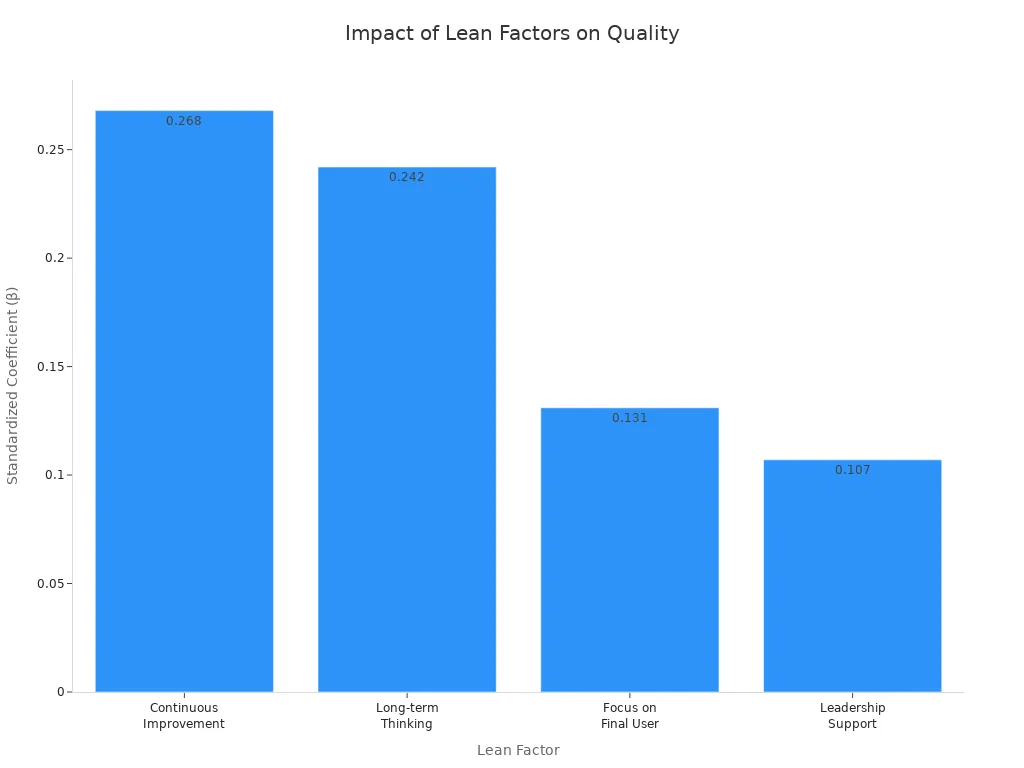
Quality challenges often prevent businesses from meeting customer expectations. Lean Thinking helps organizations overcome these obstacles by focusing on continuous improvement, long-term thinking, and leadership support. Teams use tools like value stream mapping to identify bottlenecks and remove errors from processes.
Lean Factor | Standardized Coefficient (β) | Significance (p-value) |
|---|---|---|
Continuous Improvement | < 0.001 | |
Long-term Thinking | 0.242 | < 0.001 |
Focus on Final User | 0.131 | < 0.001 |
Leadership Support | 0.107 | 0.001 |
Lean Thinking improves customer satisfaction by reducing wait times and increasing first-time resolution rates. Companies such as Amazon and Apple have used these strategies to enhance customer experiences. For example, a manufacturing team applied value stream mapping to find and eliminate production bottlenecks. This change reduced cycle times and increased throughput. In healthcare, a system redesigned its patient admission process, which minimized waiting times and improved service delivery.
Customer Value
Delivering customer value stands at the heart of Lean Thinking. Organizations use this approach to understand what customers need and remove anything that does not add value. By mapping out processes, teams reveal inefficiencies and create smoother operations. This leads to better products and services.
Lean Thinking helps organizations understand customer needs by eliminating waste and using resources effectively.
Mapping processes uncovers inefficiencies, allowing for smoother product or service delivery.
Pull systems align production with actual customer demand, improving responsiveness.
Continuous small improvements foster teamwork and accountability, leading to better customer experiences.
Companies like Amazon and Apple have enhanced customer experiences by reducing transaction errors and wait times.
Research shows that 75% of customers feel long wait times negatively affect their experience.
Organizations that focus on customer value through Lean Thinking achieve higher satisfaction and retention rates.
When companies prioritize customer value, they build loyalty and trust. Customers notice faster service, fewer errors, and a better overall experience.
Lean Thinking: Quick Results
Lean Process Steps
Define Value
Teams begin by identifying what customers truly need. They focus on areas where improvement will have the greatest impact. This step helps organizations prioritize efforts and avoid unnecessary work.
Map Value Stream
Mapping the value stream allows teams to visualize every step in a process. They pinpoint where waste occurs and highlight delays or bottlenecks. This approach makes it easier to target specific problems, such as reducing lead time or improving quality.
Create Flow
Creating flow means organizing tasks so work moves smoothly from one step to the next. Teams assemble cross-functional groups to address issues and streamline operations. This method reduces interruptions and keeps processes efficient.
Pull System
Establishing a pull system ensures production matches customer demand. Teams rely on real-time signals to guide work, which prevents overproduction and lowers inventory costs. This principle helps companies respond quickly to changing needs.
Pursue Perfection
Teams strive for perfection by making continuous improvements. They encourage regular feedback and adjust processes to eliminate waste. This mindset supports ongoing progress and higher quality outcomes.
Lean Thinking uses the principles of value, flow, pull, and continuous improvement to optimize processes and deliver rapid results.
Lean Tools
Value Stream Mapping
Value stream mapping helps teams visualize workflows and identify waste. They use this tool to highlight areas for improvement and track progress.
5S
The 5S system organizes the workplace through Sort, Set in Order, Shine, Standardize, and Sustain. Teams improve productivity and safety by keeping spaces clean and organized. This method reduces time spent searching for tools and materials.
Root Cause Analysis
Root cause analysis allows teams to investigate problems deeply. They identify the underlying causes of issues and develop solutions that prevent recurrence.
Standard Work
Standard work establishes consistent procedures for tasks. Teams document best practices and ensure everyone follows the same steps. This approach improves quality and reduces errors.
Kanban boards visualize work and process flow. Teams detect and resolve bottlenecks, which speeds up throughput.
Kaizen promotes continuous, incremental improvements. Employees collaborate to enhance efficiency and reduce waste.
Just-in-Time inventory control reduces holding costs by receiving materials only as needed.
Tip: Teams achieve quick improvements by combining Lean tools like 5S, Kanban, and Kaizen with a focus on real-time demand and workplace organization.
Speed of Implementation
Lean Thinking delivers fast results because teams target high-impact areas and use proven tools. They assemble cross-functional groups to solve problems quickly. Visual management tools, such as Kanban boards, increase transparency and help teams spot bottlenecks. The pull system aligns production with customer demand, which reduces waste and speeds up workflow. Continuous improvement ensures that teams keep making progress and sustain gains over time.
Lean Thinking in Practice
Manufacturing Example
Manufacturing companies often face challenges such as long production times, high defect rates, and wasted resources. Many organizations have adopted Lean Thinking to address these issues quickly and effectively. Teams in manufacturing settings use Lean tools to analyze workflows, identify bottlenecks, and remove unnecessary steps. This approach leads to faster production, higher quality, and lower costs.
The following table shows how well-known companies have applied Lean Thinking in their manufacturing systems and the results they achieved:
Company | Lean Application Description | Outcomes Achieved |
|---|---|---|
Nike | Restructured factory layouts to minimize worker fatigue and streamline material flow. | Reduced production cycle times and scrap rates; quality defects fell by nearly 30%. |
Intel | Integrated Lean Six Sigma to identify and reduce hidden waste in semiconductor manufacturing. | Reduced cycle times, boosted yield rates, and saved billions in opportunity costs. |
Caterpillar | Developed the Caterpillar Production System (CPS) to standardize work and improve efficiency. | Achieved double-digit productivity increases and halved quality issues; improved delivery performance. |
Boeing | Implemented cell manufacturing to reduce assembly time and improve collaboration with suppliers. | Cut assembly time by 40% and reduced inventory costs through real-time tracking. |
Tesla | Designed Gigafactories for continuous flow and agile manufacturing processes. | Optimized production processes dynamically, enhancing efficiency and reducing waste. |
These examples show that when teams focus on system-wide improvements, they can achieve rapid and measurable results. By involving employees at every level, companies create a culture of continuous improvement and problem-solving.
Service Example
Service organizations, such as healthcare providers, banks, and retail stores, use Lean Thinking to deliver better experiences for their clients. Teams in these environments map out each step of the service process to find delays and unnecessary actions. By making small, targeted changes, they improve speed and quality.
Teams give customers what they need by cutting waste.
Knowing what customers want helps use time and tools well.
Drawing out the steps shows problems and helps fix them.
Smooth steps ensure services are delivered without stops.
A pull system matches work to what customers actually need.
Small changes over time help businesses improve and stay successful.
Getting workers involved builds teamwork and makes them feel responsible.
Watching important numbers shows how well things are working and what to fix.
For example, healthcare systems have reduced patient wait times by streamlining admission and treatment processes. Software development teams have improved coding and testing workflows, leading to faster releases. Retail businesses have matched inventory to real customer demand, which reduces waste and improves satisfaction. These results come from teams working together to improve systems and respond quickly to client needs.
Office Example
Office environments also benefit from Lean Thinking. Teams in offices often face slow paperwork, unclear roles, and wasted effort. By applying Lean principles, they can streamline processes, remove unnecessary steps, and use resources more effectively.
Companies like Avalign Technologies increased Overall Equipment Effectiveness by up to 50% after removing bottlenecks and reducing waste. Zappos empowers employees to provide exceptional service, creating a vibrant workplace and happy customers. Southwest Airlines achieves high satisfaction by empowering its teams and streamlining operations.
Lean Thinking enhances efficiency and productivity by focusing on teamwork and system improvements. For instance, a healthcare office redesigned its patient admission process to minimize waiting times. This change led to smoother workflows and better service delivery. Teams that use Lean methods in office settings often see faster results, higher morale, and improved client satisfaction.
Small Business Example
Small businesses often face unique challenges. They have limited resources, smaller teams, and must adapt quickly to market changes. Lean Thinking offers practical solutions that help these businesses improve efficiency and deliver better value to customers. Many small businesses have adopted Lean methods to streamline operations and solve problems fast.
A local bakery, for example, involved its employees in regular feedback loops. The team met weekly to discuss workflow and suggest improvements. This approach encouraged everyone to share ideas and take ownership of the process. As a result, the bakery reduced waste and improved how quickly it served customers. Employees felt more engaged and motivated to keep finding better ways to work.
A small auto repair shop used the 5S system to organize its workspace. The team sorted tools, set them in order, and kept the area clean. They also standardized their routines and made sure everyone followed the same steps. This organization reduced the time spent searching for tools and lowered the number of mistakes. The shop also saw fewer safety incidents, which helped protect both workers and customers.
Boutique clothing stores often struggle with overproduction and excess inventory. One store implemented a pull system to match production with actual customer demand. The team tracked sales trends and adjusted orders based on real-time data. This method minimized unsold stock and freed up cash for other needs. The store used resources more efficiently and responded faster to changing customer preferences.
Small IT consulting firms benefit from Lean Thinking by creating a culture of continuous learning. One firm held regular workshops on Lean tools and encouraged employees to identify inefficiencies. Team members learned to spot problems early and suggest solutions. This culture empowered everyone to make improvements, leading to more consistent project delivery and higher client satisfaction.
The table below highlights how different small businesses have applied Lean Thinking and the results they achieved:
Example | Implementation Method | Result |
|---|---|---|
Local Bakery | Engaging employees in continuous improvement through feedback loops | Enhanced efficiency and employee ownership in reducing waste and improving workflow. |
Small Auto Repair Shop | Using the 5S system to organize the workspace | Reduced time searching for tools, fewer errors, and improved safety. |
Boutique Clothing Store | Implementing a pull system to align production with customer demand | Minimized overproduction and excess inventory, ensuring efficient resource use. |
Small IT Consulting Firm | Creating a culture of continuous learning through regular workshops on Lean tools | Empowered employees to identify inefficiencies and implement improvements consistently. |
Note: Lean Thinking helps small businesses achieve quick wins by focusing on simple changes that make a big difference. Teams that involve everyone in improvement efforts often see faster results and build a stronger workplace culture.
Lean Thinking does not require large budgets or complex systems. Small businesses can start with basic Lean tools and see immediate benefits. By engaging employees, organizing workspaces, and focusing on customer needs, small businesses can solve problems quickly and set the stage for long-term success.
Applying Lean Thinking
Assess Processes
Teams begin Lean Thinking by assessing their current processes. They physically follow each step to spot delays and redundancies. Frontline personnel provide valuable insights into operational bottlenecks. Leaders use process mapping tools to plan value stream mapping and highlight non-value-adding activities. Measuring cycle times and defect rates helps quantify waste and inefficiencies. This approach gives teams a clear picture of where improvements are needed.
Recommended steps for process assessment:
Walk through the process to observe delays and repeated actions.
Involve frontline workers to understand daily challenges and bottlenecks.
Use process mapping tools to visualize workflows and plan value stream mapping.
Measure cycle times and defect rates to identify areas with the most waste.
Teams that assess processes thoroughly lay the foundation for successful Lean implementation.
Identify Waste
Identifying waste is a key step in Lean Thinking. Teams use Value Stream Mapping (VSM) to visually map the flow of materials and information. VSM helps distinguish between value-added and non-value-added activities. By analyzing workflows, teams document inefficiencies such as bottlenecks and redundant steps. Engaging frontline workers in this analysis promotes collaboration and continuous improvement. Focusing on the end customer ensures that waste elimination aligns with delivering value.
Effective methods for waste identification:
Value Stream Mapping reveals where waste occurs in the process.
Teams analyze workflows to find bottlenecks and unnecessary steps.
Frontline workers participate in identifying inefficiencies.
Waste elimination efforts focus on improving customer value.
Value Stream Mapping helps teams see the entire process and pinpoint areas for improvement.
Engage Teams
Team engagement drives Lean Thinking success. Engaged employees bring innovation and adaptability, improving outcomes for customers and the organization. Practices such as Kaizen encourage participation in problem-solving and process improvements. Employees gain decision-making power and ownership of their work. Lean Thinking creates a shared understanding of roles and goals, motivating employees to suggest improvements and stay committed.
Professional development through continuous learning and training strengthens team capabilities. Prioritizing engagement leads to sustained improvement by bringing energy, creativity, and dedication to the team. Collaboration enhances knowledge sharing, visibility, and idea exchange, which improves productivity and workflow optimization.
Ways to foster team engagement:
Encourage employee participation in Kaizen activities.
Provide opportunities for professional development and training.
Build a culture of shared goals and open communication.
Promote collaboration to enhance knowledge sharing and workflow optimization.
Teams that feel empowered and involved contribute to lasting improvements and a positive workplace culture.
Start Small
Many organizations achieve success with Lean Thinking by starting small. Teams often begin with one process or department. They focus on simple changes that deliver quick wins. This approach helps build confidence and momentum. Leaders encourage employees to experiment with incremental improvements. They test new ideas and measure results before expanding Lean practices.
Small businesses benefit from Lean Thinking by streamlining operations and reducing waste. They concentrate on customer value and operational efficiency. These efforts lead to sustainable growth and higher productivity. Teams that start small can adapt quickly and learn from each change. They avoid overwhelming employees and minimize risks.
Teams make incremental changes and observe results.
Leaders encourage experimentation and learning.
Small businesses improve productivity and reduce waste.
Focusing on customer value supports sustainable growth.
Starting small fosters a mindset of innovation and continuous improvement.
Tip: Teams that start with manageable projects build a foundation for larger Lean initiatives. They gain experience and confidence as they see positive outcomes.
Track Improvements
Tracking improvements helps organizations measure the impact of Lean Thinking. Teams use clear metrics to monitor progress and identify areas for further enhancement. Leaders review data regularly and share results with employees. This transparency motivates teams and supports ongoing improvement.
The table below shows common metrics used to track Lean improvements:
Impact Area | Documented Effects and Metrics |
|---|---|
Task Completion Time | Reduced by 40-60% through streamlined workflows and bottleneck elimination. |
Productivity | Up to 35% increase in manufacturing productivity within the first year. |
Cost Savings | 25-30% reduction in operational costs via automation, waste reduction, and error minimization. |
Quality Improvements | 50% reduction in errors and defects, leading to 30% higher customer satisfaction and 45% fewer complaints. |
Market Responsiveness | Faster product launches (40% quicker), ability to adjust production in 24-48 hours, and real-time service modifications. |
Operational Metrics | Cycle time reduction (40-60%), first-time-right rate improvement (35-45%), resource utilization increase (25-35%). |
Financial Metrics | Operating cost reduction (25-30%), revenue per employee increase (20-30%), ROI of 150-200% within first year. |
Customer Metrics | Customer satisfaction improvement (30-40%), service delivery speed increase (45-55%), retention growth (15-25%). |
Teams select metrics that match their goals. They track task completion time, productivity, cost savings, and quality improvements. Leaders use these numbers to guide decisions and celebrate achievements.
Note: Regular tracking helps teams spot trends and adjust strategies. It also keeps everyone focused on continuous improvement.
Build Lean Culture
Building a Lean culture ensures lasting success. Leaders set clear expectations and model Lean behaviors. They encourage open communication and teamwork. Employees participate in improvement activities and share ideas. Teams celebrate progress and learn from setbacks.
Organizations create a culture of respect and collaboration. Leaders provide training and support. Employees gain skills and confidence to solve problems. Teams work together to deliver value and reduce waste.
Leaders model Lean behaviors and set expectations.
Teams communicate openly and share ideas.
Employees participate in improvement activities.
Organizations provide training and support.
Teams celebrate progress and learn from setbacks.
A Lean culture grows when everyone feels involved and valued. Teams sustain improvements and adapt to new challenges. Organizations achieve higher efficiency, better quality, and greater customer satisfaction.
Tip: Building a Lean culture takes time and commitment. Leaders who invest in people and teamwork create lasting change.
Lean Thinking Challenges
Common Barriers
Many organizations face obstacles when they try to adopt Lean Thinking. Some teams resist change because they feel uncertain about new methods. Employees may worry that Lean will add more work or threaten their roles. Leaders sometimes treat Lean as a short-term project instead of a long-term culture shift. This mindset can cause Lean efforts to lose momentum.
Communication gaps often slow down Lean adoption. When leaders do not explain the purpose of Lean, employees may not understand why changes are needed. Lack of training can also create confusion. Teams might use Lean tools without knowing how they work or why they matter. Without support from leadership, Lean initiatives struggle to succeed.
Note: Lean Thinking requires everyone to participate. If only a few people drive the process, improvements will not last.
Success Strategies
Organizations can overcome Lean challenges by using proven strategies. Teams see better results when they involve employees in every step of the transformation. Open communication helps everyone feel valued and included. Leaders should encourage feedback and listen to employee ideas. Early wins, even small ones, build confidence and show that Lean works.
Leadership commitment is essential. Leaders must support Lean as a core value, not just another project. They need to set an example and stay involved. Proper training helps employees understand Lean methods. Training should explain both the tools and the reasons behind them. This approach prevents shallow or incomplete Lean efforts.
Key strategies for Lean success include:
Encourage open communication and seek input from all team members.
Celebrate small, early wins to build trust in Lean methods.
Secure full buy-in and commitment from leadership.
Treat Lean as a cultural shift, not just a temporary initiative.
Provide thorough training on Lean tools and principles.
Tip: Teams that feel respected and informed are more likely to support Lean changes and suggest improvements.
Sustaining Improvements
Sustaining Lean improvements requires ongoing effort and clear communication. Leaders must set expectations and provide regular feedback. Teams need to feel accountable for results. Organizations should document what works well after each improvement. Regular audits help maintain discipline and prevent old habits from returning.
A few best practices help organizations keep Lean improvements strong:
Standardize the new way of working after each improvement.
Audit processes regularly to reinforce consistency.
Empower teams to take ownership of their work.
Use visual management tools to track and communicate progress.
Make Lean habits part of daily routines.
Develop leaders who coach and model Lean behaviors.
Teams should also set clear roles and responsibilities. Tracking progress and assigning accountability keeps everyone focused. Ongoing training helps employees maintain their skills. Celebrating successes motivates teams and keeps momentum high.
Sustained Lean success depends on commitment at every level. When organizations embed Lean into their culture, improvements last and grow over time.
Lean Thinking Benefits
Efficiency Gains
Lean Thinking transforms organizations by increasing efficiency at both the system and team levels. Teams identify waste and streamline processes, which leads to faster task completion and improved resource use. Companies that implement Lean methods often see measurable improvements in productivity and quality.
Avalign Technologies boosted Overall Equipment Effectiveness by 50% after reducing waste.
FedEx Express enhanced aircraft maintenance, raising annual C-checks from 14 to 30 while lowering man-hours from 32,715 to 21,535.
Virginia Mason Medical Center improved patient flow, resulting in shorter wait times and fewer medical errors.
These examples show that Lean Thinking helps organizations deliver services and products more quickly and reliably. Teams focus on value-added activities, which reduces delays and errors. Clients benefit from faster service and higher quality outcomes.
Lean Thinking enables organizations to achieve more with fewer resources, making operations smoother and more predictable.
Employee Engagement
Lean Thinking fosters a workplace where employees feel valued and empowered. Teams participate in improvement initiatives, which increases their sense of ownership and accountability. Engaged employees bring energy and commitment to their roles, helping organizations solve problems and innovate.
Employees provide insights that help identify waste and improvement opportunities.
Participation in Lean initiatives fosters ownership and accountability.
Engaged employees actively solve problems and propose beneficial solutions.
A longitudinal study showed that employee engagement rises after organizations implement improvement practices. Supportive leadership and effective human resource management create a respectful and safe environment. Lean Thinking encourages active participation, which leads to innovative solutions and sustained growth.
Lean Thinking significantly enhances employee engagement by creating an environment where employees feel valued. This approach motivates teams to contribute ideas and take responsibility for outcomes. Organizations benefit from higher morale and improved performance.
Customer Satisfaction
Lean Thinking places customer value at the center of every process. Teams understand clients' goals and identify areas where products or services fall short. They improve product functions and performance based on findings, which leads to higher satisfaction.
Teams understand customers' goals and where they struggle with products.
They identify product flaws and related waste in work methods.
Improvements focus on product functions and performance.
Research innovations maintain customer loyalty.
Organizations regularly provide new offers to keep customers satisfied and engaged.
Delta-Q demonstrates that continuous improvement supply chains foster ongoing growth by reassessing operations and raising standards. Lean methods measure what matters to customers and improve accordingly. This approach results in reliable, high-quality, and on-time delivery, which increases revenue and customer satisfaction.
Lean Thinking changes how organizations deliver value. Teams eliminate waste and improve flow, making processes more responsive to customer needs. Clients experience better service, fewer errors, and timely delivery. Organizations that adopt Lean Thinking build trust and loyalty, supporting sustainable business growth.
Lean Thinking empowers teams to deliver consistent quality and meet customer expectations, leading to lasting satisfaction.
Sustainable Growth
Lean Thinking supports sustainable growth by helping organizations adapt to changing markets and maintain long-term success. Teams use Lean principles to build strong foundations for future expansion. Leaders focus on continuous improvement, which keeps processes efficient and flexible. Companies that embrace Lean Thinking often see steady progress in productivity, quality, and customer satisfaction.
Growth becomes sustainable when organizations reduce waste and use resources wisely. Lean methods encourage teams to review operations regularly. They identify areas for improvement and make small changes that add up over time. This approach prevents stagnation and keeps businesses moving forward.
Lean Thinking creates a culture where innovation thrives. Employees feel empowered to suggest new ideas and solve problems. Leaders listen to feedback and support ongoing learning.
Many companies use Lean tools to track progress and set goals for growth. They measure key metrics such as cycle time, defect rates, and customer satisfaction. Teams celebrate achievements and learn from setbacks. This process builds resilience and prepares organizations for future challenges.
The table below shows how Lean Thinking contributes to sustainable growth:
Lean Practice | Impact on Growth |
|---|---|
Continuous Improvement | Drives ongoing progress and innovation |
Waste Reduction | Frees up resources for new opportunities |
Employee Engagement | Builds a motivated and adaptable workforce |
Customer Focus | Increases loyalty and market share |
Standard Work | Ensures consistency and scalability |
Lean Thinking helps organizations respond quickly to market changes. Teams adjust processes to meet new demands. Leaders use data to make informed decisions. This flexibility supports expansion into new markets and products.
Companies maintain high quality as they grow.
Teams keep costs low by eliminating waste.
Leaders build strong relationships with customers and suppliers.
Employees develop new skills and take on greater responsibility.
🌱 Sustainable growth depends on a culture of improvement and respect. Lean Thinking gives organizations the tools to build lasting success. Teams that follow Lean principles achieve steady progress and adapt to new challenges with confidence.
Note: Lean Thinking does not guarantee instant results. Sustainable growth requires patience, commitment, and a willingness to learn. Organizations that invest in Lean practices build strong foundations for the future.
Lean Thinking gives organizations a proven way to solve business problems quickly. Teams see real benefits like higher efficiency, better quality, and stronger employee engagement. Continuous improvement keeps progress steady. Companies that want to learn more or need help with Lean methods can contact our team for guidance.
Take the first step toward lasting improvement—start your Lean journey today.
FAQ
What is Lean Thinking?
Lean Thinking is a management approach that helps organizations improve processes. Teams focus on delivering value to customers and removing waste. This method supports continuous improvement and efficiency.
Who can use Lean Thinking?
Any organization can use Lean Thinking. Manufacturing, healthcare, services, and small businesses all benefit. Teams of any size can apply Lean tools to solve problems and improve results.
How does Lean Thinking reduce waste?
Lean Thinking helps teams find and remove activities that do not add value. They use tools like Value Stream Mapping and 5S to spot waste. This process leads to faster workflows and lower costs.
Is Lean Thinking only for large companies?
No. Small businesses and startups use Lean Thinking to improve operations. Lean tools work for any team that wants to increase efficiency and deliver better value.
What are the main Lean tools?
Common Lean tools include Value Stream Mapping, 5S, Kanban boards, and Root Cause Analysis. Teams use these tools to organize work, find problems, and make improvements.
How long does it take to see results with Lean Thinking?
Teams often see quick wins within weeks. Simple changes can lead to faster processes and better quality. Continuous improvement helps teams build on early success.
Does Lean Thinking require special training?
Basic Lean tools are easy to learn. Many teams start with simple methods and grow their skills over time. Training helps teams use Lean more effectively.
Can Lean Thinking improve customer satisfaction?
Yes. Lean Thinking helps teams deliver products and services faster and with fewer errors. Customers notice better quality and shorter wait times.


