Steps to Effective Business Succession Planning in 2026

A strong approach to Business Succession Planning in 2026 starts with early action, clear Systems, and a thoughtful Methodology. Many owners worry that planning is only for large organizations. However, every entrepreneur must secure the future of their business.
About 70% of family-owned businesses do not survive the transition to the second generation without a plan.
Only 12% reach the third generation.
Leaders should use all available Resources and involve multiple departments. The table below highlights common misconceptions:
Misconception | Explanation |
|---|---|
Succession planning is solely an HR responsibility | Success comes when all departments participate, not just HR. |
Key Takeaways
Start succession planning early to allow time for talent development and flexibility in decision-making.
Involve multiple departments in the planning process to ensure a comprehensive approach and avoid misconceptions.
Identify critical roles that are essential for business continuity and focus succession planning efforts on these positions.
Regularly assess the readiness of potential successors using structured tools to track their progress and development.
Communicate openly with stakeholders about succession plans to build trust and reduce uncertainty during transitions.
Document every step of the succession planning process to ensure clarity and consistency for all involved.
Review and update the succession plan at least once a year to keep it relevant and aligned with business goals.
Engage external advisors for objective guidance and expertise to navigate complex succession challenges.
Why Business Succession Planning Is Essential
Ensuring Continuity
Business Succession Planning plays a critical role in keeping organizations stable during leadership changes. Companies that lack a formal plan often face disruptions that can harm profits and employee trust.
Organizations with weak succession plans risk experiencing up to a 12% drop in annual profits due to higher senior-level turnover rates. Furthermore, studies have shown that 40% of employees lose trust in their employer during poorly managed leadership changes.
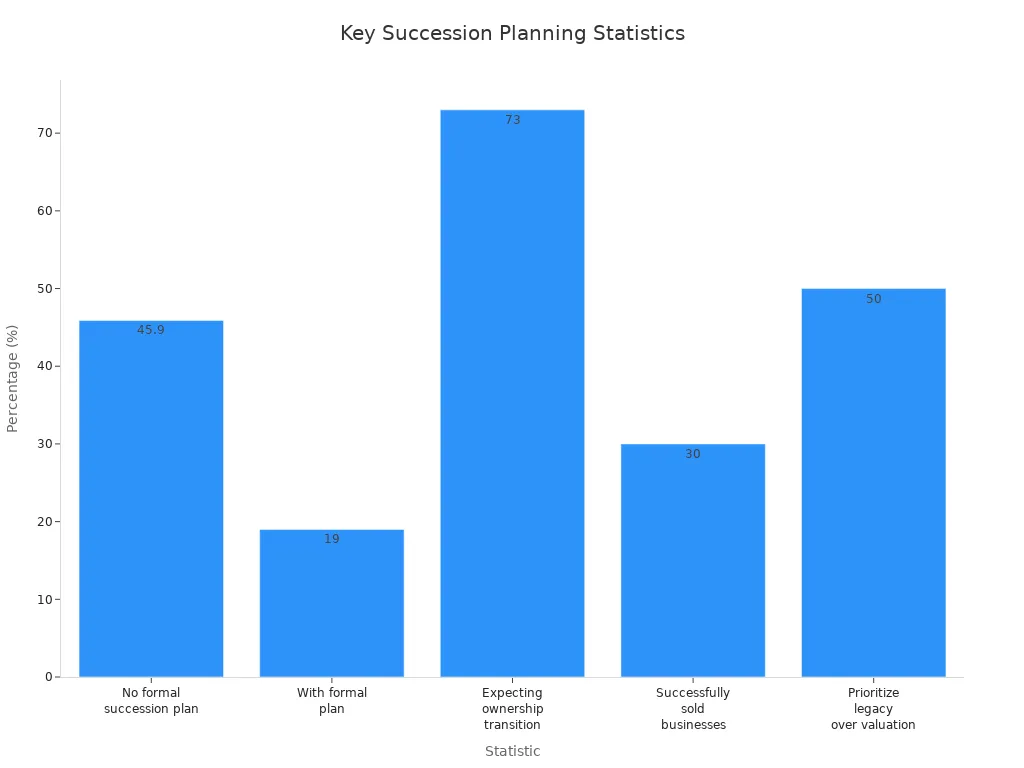
A well-prepared plan helps companies attract and keep top talent. Smooth transitions reassure employees and customers, which supports ongoing operations. The following table highlights key statistics about the current state of succession planning:
Statistic | Value |
|---|---|
Percentage of family businesses without a formal succession plan | 45.9% |
Percentage of organizations with a formalized plan | 19% |
Percentage of private companies expecting ownership transitions in the next decade | 73% |
Percentage of small businesses that successfully sell when going to market | 30% |
Percentage of owners prioritizing legacy and continuity over maximum valuation | 50% |
Protecting Legacy
Business Succession Planning helps protect the values and reputation built over years. Many owners want to see their business continue to thrive and reflect their vision. A strong plan supports this goal by:
Ensuring smooth operation after leadership changes
Minimizing disruptions that could lead to financial losses
Reducing conflicts over control of the business
Boosting morale and reassuring employees during transitions
Increasing business value through effective talent development
Anticipating and managing risks linked to leadership changes
Ensuring compliance with legal and regulatory requirements
Maintaining heritage and values while adapting to market changes
These benefits show why many owners prioritize legacy and continuity, sometimes even over maximum financial gain.
Adapting to Change
The business world changes quickly. New regulations, shifting markets, and evolving technology all require companies to stay flexible. Business Succession Planning prepares organizations to respond to both planned and unexpected changes.
Statistics reveal that companies with robust succession plans increase their ability to attract and retain top talent by up to 70%. Reports suggest that companies with robust succession plans experience smoother transitions and are better able to retain their top talent, which is directly linked to organizational performance.
Companies that identify future leaders early can respond faster to new challenges. They can also maintain stability during transitions. Conducting regular skills audits and creating growth plans for employees ensures the business has the right talent ready for key roles. This approach helps organizations remain competitive and resilient in a changing environment.
Start Early and Assess Key Roles
When to Begin Planning
Many business leaders underestimate the time needed for effective Business Succession Planning. Industry experts recommend starting the process as early as possible. A well-designed succession plan often requires five to ten years to execute successfully. Early planning gives organizations more flexibility and reduces the risk of rushed decisions. Some owners believe that one or two years is enough, but this short timeline can limit options and create unnecessary stress.
Tip: Starting early allows leaders to identify and develop talent, test potential successors, and adjust plans as business needs change.
Key reasons to begin succession planning early include:
More time to develop internal candidates for leadership roles
Greater flexibility to adapt to unexpected changes
Reduced risk of business disruption during transitions
Identifying Critical Positions
Not every role in a company requires a formal succession plan. Leaders should focus on positions that are vital to business continuity. Identifying these critical roles involves a careful review of the organization’s structure and operations. The table below outlines important criteria for determining which positions are most essential:
Criteria | Description |
|---|---|
Urgency of Succession | Roles where the incumbent is planning to leave within three years should be considered urgent. |
Impact on Business Operations | Positions central to core business functions or revenue generation should be categorized as critical. |
Unique Skillset or Knowledge Base | Roles requiring specialized skills or knowledge that are difficult to replace are deemed critical. |
Internal Bench Strength | Evaluating if there are qualified internal candidates ready to step into the role reduces vacancy risks. |
Availability of External Candidates | Assessing the difficulty of finding qualified external candidates helps identify critical roles. |
Leaders should regularly review these criteria to ensure the succession plan stays relevant as the business evolves.
Readiness Assessment
After identifying key roles, organizations must assess how prepared they are for succession. Several tools and frameworks help evaluate readiness and track progress. Common options include:
Excel templates for mapping key positions and potential successors, including details like competencies and readiness ratings
The 9 Box Grid, which evaluates employees based on performance and potential to identify high-potential candidates
The Key Role Owner Model, a structured tool for assessing candidates and tracking their readiness for critical roles
These tools offer comprehensive talent identification and detailed frameworks for evaluating both current performance and future potential. Regular assessments help leaders spot gaps in their talent pipeline and create targeted development plans.
Note: Ongoing review and adjustment of the succession plan ensure that the organization remains prepared for both expected and unexpected changes.
By starting early and focusing on the most important roles, companies can build a strong foundation for long-term success.
Build Your Succession Planning Team

A strong succession plan depends on assembling a diverse and effective team. Each member brings unique perspectives and skills that help guide the process and ensure business continuity. The team should include both internal stakeholders and external advisors who understand the organization’s needs and challenges.
Internal Stakeholders
Internal stakeholders play a vital role in Business Succession Planning. They possess firsthand knowledge of the company’s operations and culture. The following individuals often participate in the planning process:
Employees contribute insights about daily operations and potential talent within the organization.
Managers oversee departments and identify candidates for key positions.
Executives set strategic direction and approve succession plans.
These stakeholders help identify critical roles and assess the readiness of potential successors. Their involvement ensures the plan aligns with the company’s goals and values.
External Advisors
External advisors offer objective guidance and specialized expertise. They support the team by addressing complex issues and facilitating important discussions. Common external advisors include:
Professional partners provide unbiased guidance and facilitate difficult conversations.
Strategic consultants help align succession plans with business valuation and legal agreements.
Leadership coaches support the development of potential successors.
External advisors help the team navigate legal, financial, and leadership challenges. Their experience strengthens the succession plan and increases the likelihood of a smooth transition.
Defining Roles
Clear roles and responsibilities keep the succession planning team organized and focused. Best practices for defining roles include:
Identify key positions within the organization and understand the unique skills and qualities required for each role.
Assess the existing talent pool and identify potential successors.
Develop tailored plans for individuals to prepare them for future roles.
Conduct regular reviews and updates to the succession plan.
Analyze current and future needs to determine which positions are critical for business success.
Focus on roles that influence strategy, operations, and culture to ensure continuity during leadership changes.
Define clear objectives for the mentoring and coaching program.
Identify potential mentors and coaches within the organization.
Pair mentors and mentees thoughtfully, considering compatibility and development needs.
Tip: A well-defined team structure helps streamline decision-making and ensures accountability throughout the succession process.
A diverse team, clear responsibilities, and ongoing collaboration create a strong foundation for effective succession planning. This approach prepares organizations for leadership changes and supports long-term growth.
Identify and Develop Successors
Successor Selection Criteria
Selecting the right successor is a critical step in Business Succession Planning. Companies must define what they need in future leaders before making any decisions. This process starts with outlining business goals and the qualities required for success. The following table summarizes the most effective steps for selecting successors:
Step | Description |
|---|---|
1 | Define business goals for future leadership needs. |
2 | Identify necessary skills and values for the successor. |
3 | Assess candidates using performance reviews and leadership assessments. |
4 | Implement development plans including shadowing and coaching. |
5 | Ensure confidence and capability for the handover. |
Companies often use a scoring system to evaluate candidates objectively. They rate roles based on business impact and required skill level. Data such as employee turnover rates and financial impacts support these assessments. Defining leadership requirements is crucial. Each organization must consider its unique context and outline both essential and desirable qualities for successors.
Talent Pipeline Development
A strong talent pipeline ensures that organizations always have qualified candidates ready for key roles. Internal talent development forms the backbone of this process. Companies create accelerated development programs and offer cross-functional training opportunities. Mentorship initiatives and stretch assignments help employees gain new skills. Continuous learning programs keep the workforce adaptable.
Pipeline management involves regular talent mapping exercises and skills gap analysis. Organizations create talent pools for critical positions and implement early identification programs. Building relationships with educational institutions can also help attract future leaders.
Internal Talent Development:
Accelerated development programs
Cross-functional training
Mentorship initiatives
Stretch assignments
Continuous learning
Pipeline Management:
Talent mapping
Skills gap analysis
Talent pools for key roles
Early identification programs
Partnerships with schools and universities
The board should ensure ongoing support for these efforts. Development plans for top executives, challenging assignments, and exposure to non-executive directors all contribute to a robust pipeline.
Training and Mentoring
Training and mentoring programs prepare successors for leadership. Mentoring and coaching provide guidance from experienced leaders. Cross-training and structured development initiatives help employees gain diverse skills. Regular monitoring and feedback sessions keep the program aligned with organizational goals.
For example, a technology company paired a high-potential software developer with the Chief Technology Officer. This relationship gave the developer insights into leadership and strategic decision-making, preparing him for future roles.
Steps for effective training and mentoring include:
Implement formal mentoring and coaching programs.
Provide cross-functional exposure and job rotation.
Use assessment tools to track progress and identify gaps.
Matching mentors and mentees based on career goals ensures relevance. Training for mentors equips them with the skills needed to support successors effectively.
Avoiding Common Pitfalls
Many organizations face challenges when identifying and developing successors. These pitfalls can slow progress and put business continuity at risk. Leaders who understand these common mistakes can take steps to avoid them.
Focusing only on executive roles
Some companies look only at the top positions. They forget that many non-executive roles are also critical for success. Leaders should review all key positions, not just those in the C-suite.Using a one-size-fits-all approach
Generic competency frameworks may not fit every organization. Each business has unique needs. Leaders should design custom frameworks that reflect their company’s values and goals.Describing an idealized role
It is easy to list every desirable quality for a successor. However, focusing on essential skills and competencies leads to better choices. Leaders should define what is truly needed for success.Ignoring changes in the workplace
Roles often change due to new technology or industry trends. Leaders must consider how positions may evolve. They should update requirements as the business environment shifts.Keeping plans secret
Some organizations do not share their succession plans. This lack of transparency can cause talented employees to leave. Open communication helps build trust and keeps high-potential staff engaged.Relying on a single successor
Choosing only one candidate for a key role is risky. If that person leaves, the company may struggle. Leaders should develop several potential successors for each important position.Assuming past success predicts future performance
A high performer in one role may not succeed in another. Leaders should match candidates’ skills to the demands of the new position.Delegating everything to HR
Succession planning should involve the whole organization. When only HR manages the process, important insights may be missed. Leaders from all departments should participate.Failing to update the plan
A succession plan is not a one-time task. Regular reviews keep the plan relevant and effective. Leaders should schedule updates at least once a year.Not documenting the process
Clear documentation ensures everyone understands the plan. It also helps new team members follow the process if leadership changes.
Tip: Leaders who avoid these pitfalls create stronger, more flexible succession plans. They prepare their organizations for both expected and unexpected changes.
By recognizing and addressing these common mistakes, companies can build a reliable path for future leaders. This approach supports long-term growth and stability.
Business Valuation and Financial Planning
Valuation Methods
Business owners must understand the value of their company before planning a transition. Several methods help determine fair market value.
Asset-Based: This method adds up all assets and subtracts liabilities. Owners can use book value or liquidation value to estimate worth.
Income-Based: This approach projects future cash flows and discounts them to present value. Discounted cash flow analysis helps estimate earning capacity.
Market-Based: Owners compare their business to similar companies that have sold recently. Valuation multiples and comparable sales guide this process.
Each method offers unique insights. Owners often use more than one approach to get a complete picture. Accurate valuation supports informed decisions during Business Succession Planning.
Financial and Tax Strategies
Financial planning plays a key role in successful ownership transitions. Strategic foresight and adaptability help owners prepare for changes. Tax implications can affect the outcome of succession.
Owners should consider federal and state estate or gift tax exemptions. Changes in tax laws may impact planning in 2026.
Aligning the sale or transfer strategy with retirement income needs and legacy goals ensures financial security.
Structuring ownership transfers to minimize tax liabilities is critical. Trusts and buy-sell agreements can help reduce estate and gift tax impacts.
Investment management and estate planning protect assets and support long-term goals.
A certified public accountant (CPA) provides expertise in tax planning and financial analysis. They can identify areas for improvement and help determine fair market value. Owners benefit from professional advice to navigate complex financial and tax issues.
Funding the Transition
Owners must secure funding for the transfer of business ownership. Several options exist to support this process.
Description | |
|---|---|
Buy/Sell Agreements | Legal documents outlining terms for ownership transfer, often funded with life insurance. |
Seller Financing | The seller provides financing to the buyer for the purchase of the business. |
Employee Ownership (ESOP) | Structures allowing employees to acquire ownership, popular among retiring business owners. |
Other funding methods include vendor loans, staged payments, bank financing, mezzanine lending, buyer equity, debt financing, and private equity structures such as leveraged buyouts (LBOs). Employee ownership options, like Employee Stock Ownership Plans (ESOPs), are increasingly popular among owners planning retirement.
Tip: Owners should evaluate each funding option based on their goals and the needs of the business. Professional guidance helps select the best strategy for a smooth transition.
Succession Agreements and Governance
Drafting Agreements
Business succession agreements form the backbone of a successful transition. These documents outline who will take over key roles and how the process will unfold. Leaders must name a capable successor and describe preparation steps, such as training and hands-on experience. Estate planning tools, including wills, trusts, and buy-sell agreements, help manage and transfer assets. Operational continuity measures ensure management roles, customer relationships, and vendor connections remain stable during the transition. Legal compliance is essential; leaders must document ownership transfers and follow state regulations.
A well-drafted agreement protects the business from uncertainty and provides clear guidance for everyone involved.
Key elements to include when drafting succession agreements:
Identification of a capable successor
Preparation steps for the successor
Estate planning tools (wills, trusts, buy-sell agreements)
Operational continuity measures
Legal compliance documentation
Governance Policies
Strong governance policies support effective succession planning. The board holds responsibility for consistent and effective leadership. Guidelines for recruiting or appointing a new CEO help maintain stability. Competency models for key positions identify necessary skills and ensure the right fit. Internal and external evaluations of potential successors provide a balanced perspective. CEO buy-in is crucial for the process to succeed.
Starting succession planning early in a CEO’s tenure allows for the identification and development of strong internal candidates. This proactive approach minimizes emotional turmoil and aligns leadership with the strategic direction of the business.
Recommended governance policies include:
Prepare for an orderly handover through robust management development.
Develop contingency plans for sudden transitions.
Define long-term strategic direction and CEO selection criteria.
Clarify roles of the board, committee, CEO, and management.
Assess internal candidates and create development plans.
These policies help organizations maintain leadership continuity and support long-term growth.
Legal Compliance
Legal compliance protects the business from risks during succession. Companies must follow laws regarding ownership transfers, tax liabilities, and employment practices. Regular reviews of legal documentation ensure compliance with evolving regulations. Essential legal documents include wills, shareholder agreements, and power of attorney forms. Business attorneys play a vital role in drafting and reviewing these documents to ensure enforceability and alignment with the owner’s goals.
Regular updates to legal documents address changes in regulations or business circumstances and keep the succession plan current.
Important legal compliance steps:
Adhere to regulations for ownership transfers and tax liabilities
Review employment practices for compliance
Maintain and update legal documents (wills, shareholder agreements, power of attorney)
Consult business attorneys for drafting and reviewing documents
By focusing on agreements, governance, and legal compliance, organizations build a strong foundation for successful succession planning in 2026.
Document, Communicate, and Review

Plan Documentation
Clear documentation forms the backbone of Business Succession Planning. Companies must record every step to ensure transparency and consistency. Teams use structured systems to organize information and keep plans accessible. Clients at systems and teams often achieve strong results by following best practices for documentation. They create detailed records that guide transitions and reduce confusion.
The table below shows key components and their purposes:
Component | Purpose |
|---|---|
Successor Identification | Names the individual(s) who will assume key roles |
Training and Transition | Details the process for preparing and transitioning the successor |
Estate Planning Tools | Outlines legal documents for asset management and transfer |
Operational Continuity | Describes steps to maintain business operations and relationships |
Legal Compliance | Ensures all actions meet legal and regulatory requirements |
Teams update these documents regularly. They use digital systems to store and share information. This approach helps everyone stay informed and ready for changes.
Stakeholder Communication
Effective communication keeps stakeholders engaged and informed. Leaders use several strategies to share succession plans. They involve current leaders in the process, which fosters alignment and ownership. Successors receive clear information about skills needed for key roles. This motivates them to pursue development goals.
Key employees stay updated through meetings, emails, and newsletters. This reduces uncertainty and shows the organization’s commitment to fair advancement. Teams manage expectations by explaining the selection process. Transparency builds trust and maintains morale.
Regular updates help stakeholders understand the process and adapt to new leadership. Open communication supports smooth transitions and keeps everyone focused on shared goals.
Best practices for stakeholder communication include:
Engaging leaders in the succession process.
Preparing successors with clear skill requirements.
Informing key employees to reduce uncertainty.
Managing expectations to prevent surprises.
Building trust through transparency.
Facilitating smooth transitions with clear information.
Systems and teams that follow these steps often see higher morale and better cooperation during leadership changes.
Ongoing Review
Reviewing and updating succession plans ensures they stay relevant. Industry standards recommend annual reviews. Teams schedule these reviews to align plans with current business objectives and market trends. They use feedback from stakeholders to improve processes.
Regular reviews help organizations spot gaps and adjust plans before problems arise. This proactive approach keeps the business ready for both expected and unexpected changes.
Clients at systems and teams achieve practical outcomes by making reviews part of their routine. They track progress, measure success, and update documents as needed. This cycle of review and improvement supports long-term stability and growth.
Measuring Success
Business leaders need to measure the effectiveness of succession planning. They use both objective and subjective metrics to track progress and outcomes. Objective metrics provide clear numbers. Subjective metrics offer insights into employee feelings and relationships.
A well-designed succession plan uses several types of metrics. Leaders monitor these metrics to ensure the plan supports business goals and prepares future leaders. The following table shows common examples:
Metric Type | Examples of Metrics |
|---|---|
Objective Metrics | Percentage of positions filled internally, time to readiness for new roles |
Subjective Metrics | Employee engagement, job satisfaction, quality of relationships with leaders |
Objective metrics help leaders see how many key positions are filled by internal candidates. They also track how long it takes for successors to become ready for new roles. These numbers show if the talent pipeline works well.
Subjective metrics come from surveys and interviews. Leaders ask employees about their engagement and satisfaction. They also look at how well successors build relationships with other leaders. These insights help leaders understand the culture and morale during transitions.
Leaders use a mix of metrics to get a full picture. The next table explains how each metric works:
Metric Type | Description |
|---|---|
Objective Metrics | Quantitative measures like internal promotions and readiness timelines. |
Subjective Metrics | Qualitative insights from surveys on engagement and satisfaction levels. |
Common Metrics | Includes high-potential turnover and time spent in developmental roles. |
Some organizations use a Succession Readiness Index. This index assesses candidates’ skills and performance. Leaders also track the Internal Promotion Rate. This rate shows how often employees move into leadership roles. Depth of Bench measures how many qualified successors are available for key positions. Leadership Competency Growth evaluates improvements in essential leadership skills. Turnover Rates among High-Potential Employees monitor the retention of top talent.
The table below summarizes these important metrics:
Metric | Description |
|---|---|
Succession Readiness Index | Assesses candidates’ readiness based on their skills and performance. |
Internal Promotion Rate | Tracks the frequency of internal promotions to leadership roles. |
Depth of Bench | Measures the number of qualified successors available for key positions. |
Leadership Competency Growth | Evaluates improvements in essential leadership skills among potential successors. |
Turnover Rates among High-Potential Employees | Monitors the retention of top talent critical to succession planning. |
Leaders who measure success regularly can spot gaps early. They adjust development plans and improve succession strategies. This approach helps organizations stay strong during leadership changes.
Leaders should review these metrics at least once a year. They use the results to guide training, mentoring, and talent development. By measuring success, organizations build a reliable path for future growth and stability.
Business Succession Planning in 2026 requires a clear and proactive approach. Companies should follow these steps:
Identify critical roles.
Collaborate with professionals.
Assess leadership needs.
Communicate clearly.
Manage transitions.
Address legal and financial actions.
Monitor progress.
Document the plan.
Early planning brings stability, continuity, and cultural integrity. Organizations that act now prepare for future challenges. For guidance, readers can reach out to learn how systems and teams support successful transitions.
FAQ
What is business succession planning?
Business succession planning prepares a company for leadership changes. It identifies key roles, selects potential successors, and creates a plan for smooth transitions. This process protects business continuity and legacy.
When should a company start succession planning?
Experts recommend starting succession planning as soon as possible. Early action gives leaders time to develop talent and adjust plans. Companies benefit from ongoing reviews and updates.
Who should be involved in succession planning?
A succession planning team includes executives, managers, employees, and external advisors. Each member brings unique skills and perspectives. Collaboration ensures the plan meets business needs.
How often should a succession plan be reviewed?
Annual reviews help keep succession plans current. Leaders update plans to reflect changes in business goals, market trends, and employee readiness. Regular reviews support stability.
What are common mistakes in succession planning?
Companies often focus only on executive roles, use generic frameworks, or fail to communicate plans. Leaders should avoid relying on a single successor and update plans regularly.
How does succession planning affect employee morale?
Transparent succession planning builds trust and reduces uncertainty. Employees feel valued when leaders communicate plans and offer development opportunities. This approach supports engagement and retention.
What legal documents are needed for succession planning?
Essential documents include wills, trusts, shareholder agreements, and power of attorney forms. Business attorneys help draft and review these documents to ensure compliance.
How can a company measure succession planning success?
Leaders track metrics like internal promotion rates, readiness timelines, and employee engagement. Surveys and performance reviews provide insights into the effectiveness of the plan.


